




Dusky Slugs
mesarion
Dusky slugs are fascinating creatures that glide smoothly on their slimy trails. They come out to play during wet nights and are great at munching on decaying leaves!
Habitat: Dusky slugs live in damp, shady areas like forests and gardens.
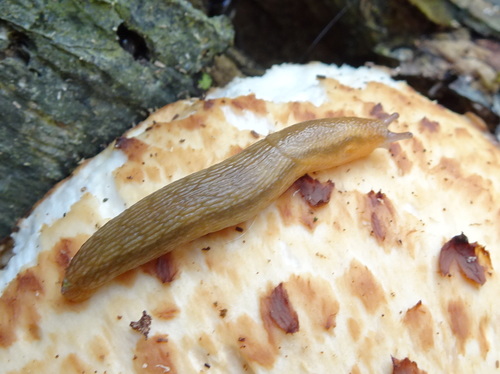
The Dusky Slug has a long, cylindrical body, typically dark gray to brown, often with subtle speckles or bands. It has two pairs of retractable tentacles and lacks an external shell, making it appear streamlined compared to snails.
Category
InvertebrateRarity
Common
Danger
0/5 · No known danger
Snaps
Be the first to snap!
A slug's slime trail helps it stick to surfaces, even allowing it to crawl upside down!
Dusky slugs are hermaphrodites, meaning each one has both male and female reproductive organs!
Some slugs can survive by burrowing deep underground during very cold or dry weather!
They can retreat their sensitive eye stalks into their head for protection from danger.
Dusky Slugs have a ribbon-like radula with tiny teeth that helps them scrape food off surfaces and chew tough plants.
Dusky Slugs have a unique breathing pore called a pneumostome that helps them take in oxygen directly from the air.
Dusky Slugs are important decomposers, eating decaying plants, algae, and fungi.
Turdus merula
Birds frequently feed on slugs found in gardens and forests.
Rana temporaria
Amphibians are key predators of slugs, especially after rain.

Pterostichus melanarius
Some ground beetles are predators of slugs, especially juveniles.
Agaricus campestris
Slugs often consume a variety of fungi, including common mushrooms.
Solitary animals live alone for most of their lives, only interacting with others for mating or parental care.
This trait characterizes organisms whose diet consists entirely or primarily of plant material.
Describes organisms that break down dead organic material, recycling nutrients back into the ecosystem.
Forest habitats are terrestrial environments dominated by dense tree cover, supporting a high diversity of plant and animal life.
Nocturnal animals are primarily active during the nighttime hours, typically resting or sleeping during the day.
Danger
0/5 · No known danger
No special safety notes yet.
Compare body symmetry, shells, segments, legs, tentacles and how the animal moves. Invertebrates span many unrelated groups, so start with body structure. Invertebrate Identifier: upload a photo and compare the visible details.
4.5 cm
2 g
2 years
0.005 km/h
Dusky Slugs are important decomposers, eating decaying plants, algae, and fungi.
Dusky slugs live in damp, shady areas like forests and gardens.
Foraging
Zoom in to split clusters and explore where this object has been snapped.
Recent snaps will appear here as new observations are added.
Take the discovery with you
Snap it with Snappit to identify it, learn what makes it special, and add the discovery to your collection.