


Eastern Beebalm
monarda bradburyana
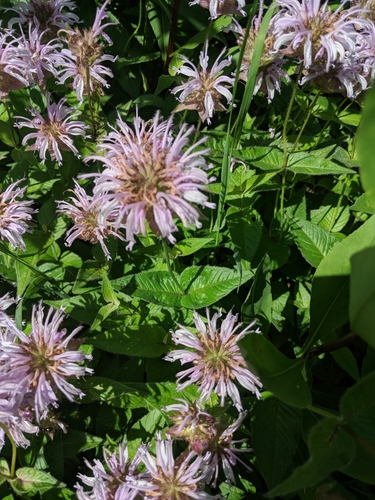
Eastern Beebalm, scientifically known as Monarda bradburyana, is a delightful perennial wildflower native to the open woodlands and rocky glades of the central United States. Named in honor of the 19th-century English naturalist John Bradbury, this plant is one of the earliest beebalms to bloom in spring, bringing life to the forest floor with its crown-like clusters of pale pink flowers. Beyond its striking visual appeal, Eastern Beebalm is famous for its highly aromatic foliage, which releases a pleasant, oregano-like scent when bruised or crushed. This fragrance serves a dual purpose, acting as a defense mechanism against herbivores while inviting a parade of essential native pollinators, including bumblebees and butterflies, to feast on its sweet nectar.
Habitat: Typically found in dry, open rocky woodlands, limestone glades, savannas, and bluff edges.
This herbaceous perennial grows to about 30 to 60 centimeters tall, featuring square stems characteristic of the mint family. Its leaves are grayish-green, ovate, and opposite, often displaying a purplish tint, especially on the veins and undersides. The flower heads are tight terminal clusters consisting of tubular, two-lipped flowers that are pale pink to white, intricately marked with fine purple dots on the lower lip. The entire flower head is subtended by distinctive, wide bracts that are strongly tinged with purple or bronze, giving the plant a regal appearance.
Category
PlantsRarity
Common
Danger
1/5 · Very low
Snaps
Be the first to snap!
Like other members of the mint family, Eastern Beebalm has distinctive square-shaped stems that are easily felt when rolled between your fingers.
Native Americans and early settlers used leaves from Monarda species to brew herbal teas to treat ailments like colds, sore throats, and headaches.
The species name 'bradburyana' honors John Bradbury, a British botanist who collected plants in the interior of North America in the early 1800s.
The leaves produce volatile oils like thymol, which emit a strong oregano-like scent that deters mammalian herbivores from grazing on its leaves.
It blooms earlier in the spring than most other Monarda species, providing a critical early food source for emerging native bees and hummingbirds.
Possesses a fibrous root system that allows it to thrive in dry, rocky, and shallow soils where other wildflowers might wither.
As a photoautotrophic plant, Eastern Beebalm generates its own energy through photosynthesis, using sunlight, water, and carbon dioxide.

Archilochus colubris
Feeds on nectar and serves as an important pollinator.
Bombus pensylvanicus
Pollinates the flowers while gathering nectar and pollen.
Lintneria eremitus
Caterpillars feed on the foliage of Monarda species.
No trait badges are assigned for this object yet.
No aliases listed yet.
Collections for this object will appear here as more themes are added.
Danger
1/5 · Very low
No special safety notes yet.
Start with the whole plant, then compare leaf arrangement, leaf edges, stems and any flowers or fruit. Opposite leaves grow in pairs; alternate leaves come one at a time along the stem. These details tell you far more together than a single green leaf does. Plant Identifier: upload a photo and compare the visible details.
30-60 cm
3-8 years
As a photoautotrophic plant, Eastern Beebalm generates its own energy through photosynthesis, using sunlight, water, and carbon dioxide.
Typically found in dry, open rocky woodlands, limestone glades, savannas, and bluff edges.
Zoom in to split clusters and explore where this object has been snapped.
Recent snaps will appear here as new observations are added.

Missouri, US
You might spot Rose Vervain, Three-Toed Box Turtle, and Christmas Fern.
View guide →
Missouri, US
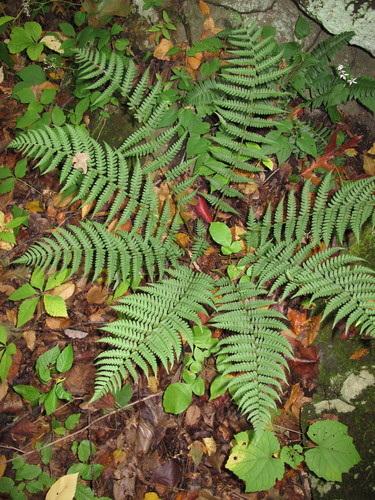
You might spot Marginal Wood Fern and Common Map Turtle.
View guide →

Missouri, US
You might spot Christmas Fern, Prairie Trillium, and Eastern Beebalm.
View guide →
Take the discovery with you
Snap it with Snappit to identify it, learn what makes it special, and add the discovery to your collection.

















