





Queen Anne's Lace
Daucus carota
Queen Anne's Lace is a delicate wildflower with lacy white flowers that look like tiny snowflakes. It grows in fields and along roadsides, attracting butterflies and bees with its sweet nectar.
Habitat: Fields, Roadsides
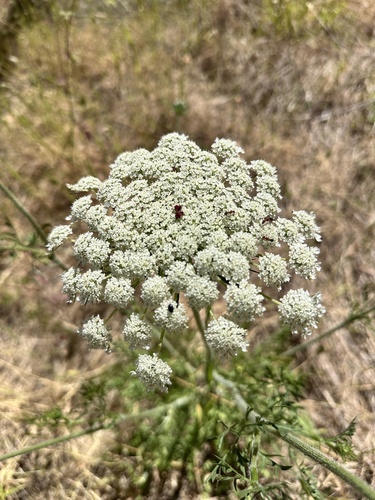
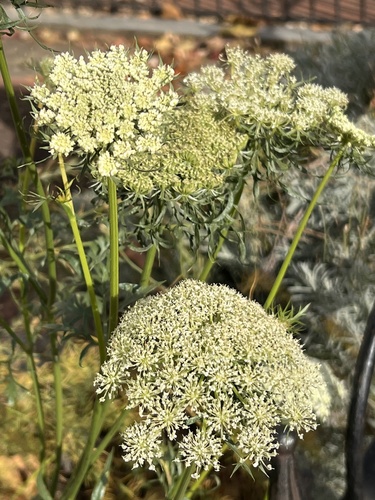
The Queen Anne's Lace has flat-topped clusters of tiny white flowers, creating a delicate, lacy appearance. Often, a single dark red or purple flower sits at the center of the main cluster, making it distinct. Its leaves are finely divided and feathery.
Category
PlantsRarity
Common
Danger
2/5 · Low
Snaps
61
Early American colonists used its seeds to make a natural yellow dye!
It can grow almost anywhere, even in poor soil, making it super adaptable!
The tiny dark dot in its center may trick insects into visiting more flowers.
This plant is the wild ancestor of all domesticated carrots we eat today!
Queen Anne's Lace has a strong taproot that stores energy, helping it grow quickly in its second year.
Its seeds have tiny hooks that let them easily stick to animal fur or clothes, traveling to new places.
The flower clusters can flatten in the sun and curl inward like a cup at night to protect the blooms.
Apis mellifera
collects nectar and pollen
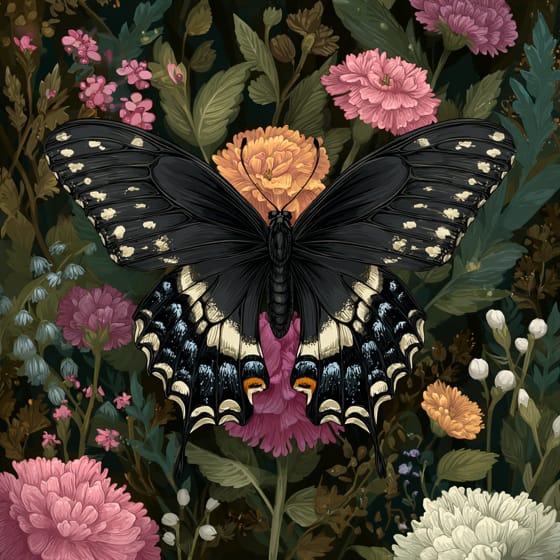
Papilio polyxenes
larvae feed on leaves and flowers
Coccinella septempunctata
finds cover among the dense flowers

Odocoileus virginianus
browses on leaves and stems
Biennial plants complete their life cycle over two growing seasons, typically forming foliage in the first year and flowering/seeding in the second.
Cluster flowers are inflorescences where individual flowers are arranged closely together on a common stem.
Spring blooming plants produce their flowers during the spring season, often signifying the end of winter and the start of new growth.
Fragrant flowers emit a pleasant aroma, often to attract pollinators or for defense.

Edible plants are those parts of a plant that are considered safe for human consumption.
Danger
2/5 · Low
Enjoy looking at Queen Anne's Lace, but do not touch or eat wild plants without an adult's permission.
The easiest way to identify Queen Anne's Lace is to use the Snappit nature identifier app.
30-150 cm
30-60 cm
5-10 cm
Summer
Yes
Mild
Biennial
Zoom in to split clusters and explore where this object has been snapped.
Jun 3, 2026
Armstrong Redwoods State Natural ReservePhoto attribution
no rights reserved
License: CC0 1.0 ↗
Image may be shown cropped inside the card frame.
Dec 6, 2024
Capitol HillPhoto attribution
(c) Frederick Nunley, some rights reserved (CC BY)
License: CC BY 4.0 ↗
Image may be shown cropped inside the card frame.

California, US
You might spot Redwood Sorrel, Redwood, and Button's Banana Slug.
View guide →

Rhode Island, US
You might spot Common Mugwort, Duck, and Azure Bluet.
View guide →

California, US
You might spot Redwood, Pacific Trillium, and Evergreen Huckleberry.
View guide →

Oregon, US
You might spot Duck, Pacific Trillium, and Wood Duck.
View guide →

Arkansas, US
You might spot Widow's-Cross, Yucca Giant-Skipper, and Outis Skipper.
View guide →

US
You might spot Wharf Louse, Osprey, and Ruddy Turnstone.
View guide →
Take the discovery with you
Snap it with Snappit to identify it, learn what makes it special, and add the discovery to your collection.








.jpg&width=800)


_001.jpg&width=800)



