




Emaravirus
emaravirus
Emaraviruses are a unique and fascinating genus of plant-infecting RNA viruses belonging to the family Fimoviridae. These microscopic pathogens are distinct for their multipartite genomes, meaning their genetic blueprint is divided into several separate segments of single-stranded RNA. Unlike many other plant viruses, emaraviruses cannot easily spread on their own or through mechanical contact. Instead, they rely on a highly specialized relationship with microscopic eriophyid mites, which act as specific vectors to carry them from host to host. Emaraviruses are responsible for causing several notable agricultural and ecological plant diseases globally.
Habitat: Typically found inside the vascular tissue and cells of host plants, as well as within the bodies of their specialized eriophyid mite vectors.
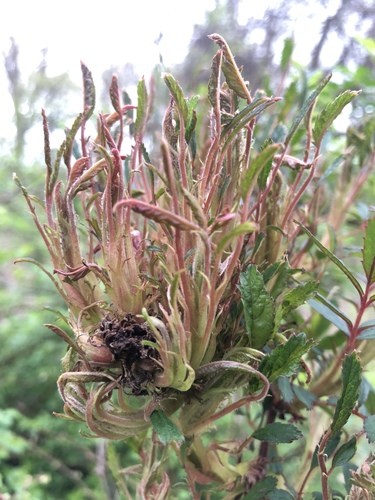
Because emaraviruses are microscopic virions measuring only 80 to 100 nanometers in diameter, they cannot be seen directly with the naked eye. Spotters can instead identify their presence by the distinctive symptoms they produce on infected host plants. These symptoms include striking yellow ringspots, mosaic patterns on leaves, leaf distortion, and 'witches' broom'—an abnormal, dense bunching of twigs and branches that resembles a broom. On roses, an infection often causes a bright red discoloration of leaves and stems and a proliferation of unusually soft, thick thorns.
Category
AnimalRarity
Common
Danger
1/5 · Very low
Snaps
Be the first to snap!
Eriophyid mites can carry the virus within their gut and salivary glands, passing it on to new leaves as they feed.
The genus name 'Emaravirus' is an acronym derived from the first identified species: European mountain ash ringspot-associated virus (EMARAV).
Unlike many viruses with simple genetic strands, emaraviruses have a highly complex, fragmented genome split into up to eight separate envelopes.
Exploits microscopic, four-legged eriophyid mites to achieve highly specific transport and transmission from plant to plant.
Utilizes a multipartite RNA structure of four to eight segments, allowing the virus to easily adapt and rapidly evolve.
Successfully hijacks the plant host's translation machinery to produce viral proteins, bypassing the plant's immune defenses.
Emaraviruses do not consume physical food; instead, they replicate by extracting metabolic resources and cellular machinery directly from infected plant cells.
Phyllocoptes fructiphilus
Uses this microscopic mite as a highly specific vector to transmit the Rose Rosette Virus to host rose bushes.

Sorbus aucuparia
Serves as a major host plant for the European Mountain Ash Ringspot-Associated Virus, leading to leaf chlorosis.

Rosa multiflora
Infects this invasive rose species, causing rapid stem elongation and leaf distortion.
Social animals live in organized groups, cooperating for survival benefits such as foraging, defense, and raising offspring.
Colorful describes organisms or objects displaying a wide range of bright and distinct colors.
This trait characterizes organisms whose diet consists entirely or primarily of plant material.
Diurnal animals are primarily active during daylight hours, typically resting or sleeping at night.
Describes organisms that transfer pollen, enabling the fertilization and reproduction of plants.
Collections for this object will appear here as more themes are added.
Danger
1/5 · Very low
No special safety notes yet.
The easiest way to identify Emaravirus is to use the Snappit nature identifier app.
Emaraviruses do not consume physical food; instead, they replicate by extracting metabolic resources and cellular machinery directly from infected plant cells.
Typically found inside the vascular tissue and cells of host plants, as well as within the bodies of their specialized eriophyid mite vectors.
Parasitic Cell Invasion
Zoom in to split clusters and explore where this object has been snapped.
Recent snaps will appear here as new observations are added.
Take the discovery with you
Snap it with Snappit to identify it, learn what makes it special, and add the discovery to your collection.