European Flat Oyster
ostrea edulis
The European Flat Oyster is a fascinating sea creature that lives in the ocean. These oysters can create beautiful pearls and are often found in sandy or muddy seabeds!
Habitat: Coastal waters and shallow sea beds in Europe.
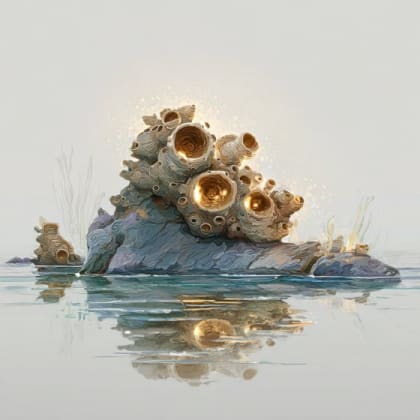
The European Flat Oyster has a distinctive flattened, round-to-oval shell, typically rough and often grey, green, or brown, sometimes with purple flecks. Its lower valve is flat, while the upper one is slightly cupped and irregular, differentiating it from cupped oysters.
Category
InvertebrateRarity
Common
Danger
0/5 · No known danger
Snaps
4
Ancient Romans loved eating European Flat Oysters, bringing them from afar for feasts!
Each oyster has a powerful muscle to keep its shell tightly closed, protecting itself!
Oysters breathe underwater by extracting oxygen directly from the water using their gills!
They don't make the famous round pearls, but can create tiny, irregular ones!
European Flat Oyster can filter many liters of water daily because they feed by drawing water through their gills, cleaning the environment.
European Flat Oyster has the ability to change its sex from male to female and back again, which helps them reproduce successfully.
European Flat Oyster can permanently attach to hard surfaces like rocks or other shells using a natural cement, anchoring them securely.
European Flat Oyster can form dense aggregations over time, creating living oyster reefs that provide homes for other marine life.
They slurp up tiny algae and other bits suspended in the water, helping keep it clean.
Asterias rubens
Starfish can pry open and eat oysters.
Carcinus maenas
Crabs use strong claws to crush or open shells.
Alexandrium catenella
Oysters filter and consume these microscopic algae.
Solitary animals live alone for most of their lives, only interacting with others for mating or parental care.
Filter feeders obtain nutrients by straining suspended food particles and small organisms from water.
Describes organisms that break down dead organic material, recycling nutrients back into the ecosystem.
Aquatic habitats encompass environments where organisms live predominantly in water, including oceans, rivers, lakes, and wetlands.

Marine habitats encompass all saltwater environments of the Earth's oceans, supporting an immense diversity of aquatic life.
Danger
0/5 · No known danger
No special safety notes yet.
The easiest way to identify European Flat Oyster is to use the Snappit nature identifier app.
8 cm
75 g
20 years
They slurp up tiny algae and other bits suspended in the water, helping keep it clean.
Coastal waters and shallow sea beds in Europe.
Filter Feeding
Zoom in to split clusters and explore where this object has been snapped.

Massachusetts, US
You might spot Common Eastern Bumble Bee and Asian Lady Beetle.
View guide →

US
You might spot Common Eider, American Herring Gull, and Common Periwinkle.
View guide →

Massachusetts, US
You might spot European Flat Oyster and Staghorn Sumac.
View guide →
Take the discovery with you
Snap it with Snappit to identify it, learn what makes it special, and add the discovery to your collection.