





European Honey-buzzard
Pernis apivorus
The European Honey-buzzard is a special bird that loves to eat wasps and bees! With its long wings and beautiful colors, it soars high in the sky, looking for food in forests and fields.
Habitat: Forests
The European Honey-buzzard has unique pale underparts with distinct barring on its tail and dark primary wing feathers. Its head is relatively small with striking yellow eyes, differentiating it from the more robust Common Buzzard.
Category
BirdsRarity
Common
Danger
1/5 · Very low
Snaps
Be the first to snap!
Some honey-buzzards have dark patterns that make them look like dangerous goshawks to scare away enemies!
Their nostrils can close almost completely, stopping dirt and stinging insects from getting in!
They rub their feathers with formic acid from ants, which helps keep nasty parasites away.
Unlike most raptors, they often walk on the ground, poking around for food with their beaks.
European Honey-buzzard has thick, overlapping feathers and specialized scales protecting them from stings, allowing them to dig up wasp nests safely.
European Honey-buzzard has powerful talons and a strong beak that helps them excavate deep into soil to reach hidden wasp larvae.
European Honey-buzzard can spot camouflaged wasp nests from high above because of its incredibly sharp eyesight, even through dense canopy.
These birds mainly feast on tasty insect larvae, pupae, and honey found in underground nests!
Vespula vulgaris
Main prey, eating larvae and pupae from their nests.
Apis mellifera
Feeds on honey and larvae from their nests.
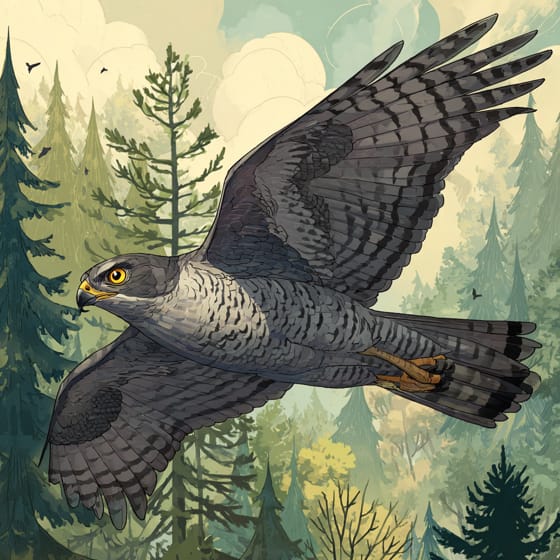
Accipiter gentilis
Goshawks may predate honey-buzzard eggs or chicks in nests.
Feathered describes animals, primarily birds, possessing a covering of feathers.
Solitary animals live alone for most of their lives, only interacting with others for mating or parental care.
Camouflaged describes organisms that possess coloring or patterns that allow them to blend into their environment.
Colorful describes organisms or objects displaying a wide range of bright and distinct colors.

Forest habitats are terrestrial environments dominated by dense tree cover, supporting a high diversity of plant and animal life.

This trait identifies organisms whose diet consists entirely or primarily of animal tissue.

Diurnal animals are primarily active during daylight hours, typically resting or sleeping at night.

Describes a species whose presence and role have a disproportionately large effect on its environment.

Migratory animals undertake seasonal movements from one region to another, typically in response to changes in climate or food availability.
No aliases listed yet.
Danger
1/5 · Very low
Always watch birds from a distance and never try to touch or catch them.
The easiest way to identify European Honey-buzzard is to use the Snappit nature identifier app.
52-60 cm
110-135 cm
0.5-1.1 kg
10-25 years
70 km/h
These birds mainly feast on tasty insect larvae, pupae, and honey found in underground nests!
Forests
Zoom in to split clusters and explore where this object has been snapped.
Recent snaps will appear here as new observations are added.
Take the discovery with you
Snap it with Snappit to identify it, learn what makes it special, and add the discovery to your collection.




.jpg&width=800)





