





European Pasqueflower
Pulsatilla vulgaris
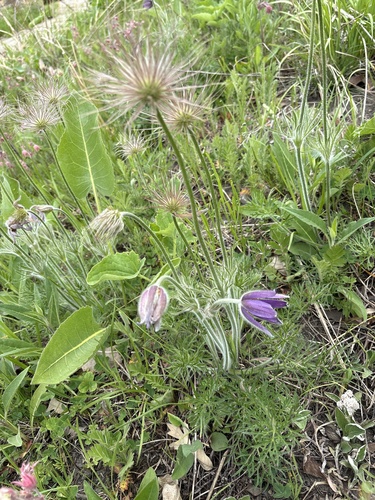
The European Pasqueflower is a beautiful flower that blooms in spring. Its soft, purple petals look like little bells and attract many happy bees and butterflies!
Habitat: Grasslands
The European Pasqueflower has deeply cut, fern-like leaves and furry stems that support large, bell-shaped flowers. These vibrant blossoms typically appear in shades of purple, but can also be white or reddish, making them distinctively fuzzy and colourful against the early spring landscape.
Category
PlantsRarity
Common
Danger
1/5 · Very low
Snaps
1
After blooming, its seed heads look just like fluffy, purple-grey wigs!
Ancient Romans believed Pasqueflowers grew in places where the blood of gods had spilled!
It closes its beautiful flowers at night and on cloudy days to protect its precious insides.
Its name 'Pasque' comes from the old French word for Easter, as it often blooms around that time!
European Pasqueflower has a coat of fine hairs on its stems and buds that helps it stay warm in the chilly early spring air.
European Pasqueflower's bell-shaped flowers often nod downwards, protecting its pollen and nectar from rain and cold winds.
European Pasqueflower produces feathery, plume-like seeds that can catch the wind and float far away to find new homes.
Apis mellifera
Early spring nectar source
Bombus pascuorum
Attracted to its colourful flowers
Rhizophagus irregularis
Forms beneficial root association
Furry describes animals possessing a dense covering of soft hair or fur.
Bell-shaped flowers possess petals fused or arranged to form a cup-like or campanulate structure resembling a bell.
Flowering plants are any plants that produce flowers as part of their reproductive cycle.
Biennial plants complete their life cycle over two growing seasons, typically forming foliage in the first year and flowering/seeding in the second.

Spring blooming plants produce their flowers during the spring season, often signifying the end of winter and the start of new growth.

Fragrant flowers emit a pleasant aroma, often to attract pollinators or for defense.

Grassland habitats are terrestrial biomes dominated by grasses and herbaceous plants, supporting a variety of grazing animals.

Describes plants that are particularly attractive and beneficial to a wide range of pollinating organisms.
No aliases listed yet.
Danger
1/5 · Very low
Do not touch or eat flowers without asking an adult first.
The easiest way to identify European Pasqueflower is to use the Snappit nature identifier app.
10-30 cm
10-20 cm
4-8 cm
Early spring
No
Moderate
Perennial
Zoom in to split clusters and explore where this object has been snapped.
May 17, 2026
Minnesota Landscape ArboretumPhoto attribution
(c) Bob, some rights reserved (CC BY)
License: CC BY 4.0 ↗
Image may be shown cropped inside the card frame.
Take the discovery with you
Snap it with Snappit to identify it, learn what makes it special, and add the discovery to your collection.









.jpg&width=800)


_001.jpg&width=800)




