





European Rhinoceros Beetle
Oryctes nasicornis
The European Rhinoceros Beetle is a big, strong bug with a horn on its head! They are usually black or brown and love to munch on rotting wood and fruit.
Habitat: Forests
The European Rhinoceros Beetle is a large, sturdy insect with a glossy, dark reddish-brown to black exoskeleton. Males are easily identified by a prominent, curved horn on their head, absent in females, making them visually distinct.
Category
InsectsRarity
Common
Danger
1/5 · Very low
Snaps
1
Adult European Rhinoceros Beetles often don't eat solid food at all, only sipping liquids.
Male rhinoceros beetles' horns are just for show and fighting, not for eating!
The larvae of this beetle can grow as big as a child's finger before turning into adults.
These beetles make a loud, hissing sound by rubbing body parts together when scared.
European Rhinoceros Beetle has incredible strength that helps them push through soil and lift objects many times their own weight.
European Rhinoceros Beetle can use its impressive horn to dig tunnels through decaying wood and soil, creating homes.
European Rhinoceros Beetle larvae live hidden underground for years, safely growing while munching on decaying wood.
European Rhinoceros Beetle can fly powerfully at night, using their wings to search for mates and food sources.
Adults sip tree sap; larvae feast on decaying wood and compost for years.
Age differences: Larvae eat decaying wood and compost, while adults primarily feed on tree sap or may not eat much.

Strix aluco
Adult beetles are prey for nocturnal birds.
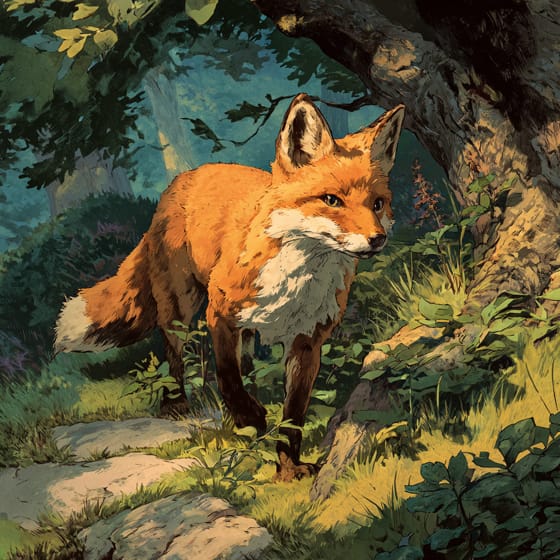
Vulpes vulpes
Foxes may dig up larvae or consume adult beetles.
Scolia flavifrons
Wasp larvae feed inside the beetle's grub.
Social animals live in organized groups, cooperating for survival benefits such as foraging, defense, and raising offspring.
Solitary animals live alone for most of their lives, only interacting with others for mating or parental care.
Characterized by having one or more hard, permanent, pointed projections on the head.
This trait characterizes organisms whose diet consists entirely or primarily of plant material.

Describes organisms that break down dead organic material, recycling nutrients back into the ecosystem.

Forest habitats are terrestrial environments dominated by dense tree cover, supporting a high diversity of plant and animal life.

Armored describes animals protected by a hard, external covering or shell for defense.

Diurnal animals are primarily active during daylight hours, typically resting or sleeping at night.

Describes a species whose presence and role have a disproportionately large effect on its environment.

Giant describes organisms or objects of significantly larger size than average for their species or type.
No aliases listed yet.
Danger
1/5 · Very low
These beetles are not harmful, but it's best to watch them from a distance.
The easiest way to identify European Rhinoceros Beetle is to use the Snappit nature identifier app.
40-70 mm
20-40 mm
60-120 days
15 km/h
Adults sip tree sap; larvae feast on decaying wood and compost for years.
Forests
Foraging
Zoom in to split clusters and explore where this object has been snapped.
Take the discovery with you
Snap it with Snappit to identify it, learn what makes it special, and add the discovery to your collection.





.jpg)



.jpg&width=800)


