


Facchinia Cerastiifolia
facchinia cerastiifolia
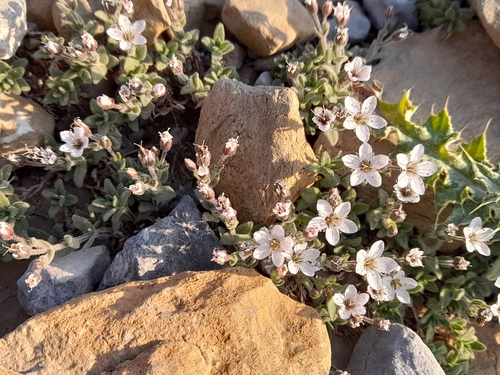
Facchinia Cerastiifolia, commonly known as the cerastium-leaved facchinia, is a resilient alpine perennial plant belonging to the pink family (Caryophyllaceae). Endemic to the rocky, wind-swept heights of the European Alps—most notably the Dolomites—this remarkable species has evolved to thrive in some of the most inhospitable environments on Earth. Clinging tightly to limestone crevices and shifting scree slopes, it forms low, dense, moss-like cushions that protect it from extreme cold and drying winds. During the short alpine summer, these green cushions transform as they erupt with a spectacular display of small, star-shaped white flowers. This sudden burst of life not only brightens the grey limestone landscapes but also plays a vital role in attracting high-altitude pollinators, serving as an ecological pioneer in stabilizing fragile mountain soils.
Habitat: Found in alpine screes, rocky crevices, and limestone cliffs at high elevations.
This species forms dense, low-growing, bright green cushions or tufts, typically reaching heights of only 2 to 10 centimeters. Its leaves are small, narrow, linear-lanceolate, and closely arranged along the stems, strongly resembling those of the genus Cerastium. The flowers are small, measuring roughly 8 to 12 millimeters in diameter, featuring five distinct white petals that are slightly longer than the pointed green sepals beneath them.
Category
PlantsRarity
Common
Danger
1/5 · Very low
Snaps
Be the first to snap!
Despite growing in freezing alpine zones, its dense foliage prevents ice crystals from forming inside the core of the cushion, acting as a natural insulation blanket.
Its species name 'cerastiifolia' translates directly to 'leaves like Cerastium', highlighting the similarity of its foliage to mouse-ear chickweed.
The cushion-like growth form of Facchinia Cerastiifolia acts as an 'ecosystem engineer', trapping organic debris and creating richer soil that other alpine plants can colonize.
Forms tight, compact cushions that trap heat and moisture, maintaining internal temperatures significantly warmer than the freezing ambient alpine air.
Possesses highly elastic stems and a deep taproot that allow the plant to withstand shifting gravel and heavy snow loads without snapping.
Capable of performing photosynthesis at near-freezing temperatures, allowing it to maximize food production during short alpine growing seasons.
As a photoautotroph, this plant produces its own organic compounds using sunlight, carbon dioxide, water, and essential mineral nutrients absorbed from the soil.
Bombus alpinus
Pollinated by high-altitude insects seeking nectar during the brief summer bloom.

Capra ibex
Occasionally grazed upon by high-altitude herbivores adapted to steep rocky terrains.
No trait badges are assigned for this object yet.
No aliases listed yet.
Collections for this object will appear here as more themes are added.
Danger
1/5 · Very low
No special safety notes yet.
Start with the whole plant, then compare leaf arrangement, leaf edges, stems and any flowers or fruit. Opposite leaves grow in pairs; alternate leaves come one at a time along the stem. These details tell you far more together than a single green leaf does. Plant Identifier: upload a photo and compare the visible details.
2+ cm
10+ years
As a photoautotroph, this plant produces its own organic compounds using sunlight, carbon dioxide, water, and essential mineral nutrients absorbed from the soil.
Found in alpine screes, rocky crevices, and limestone cliffs at high elevations.
Zoom in to split clusters and explore where this object has been snapped.
Recent snaps will appear here as new observations are added.
Take the discovery with you
Snap it with Snappit to identify it, learn what makes it special, and add the discovery to your collection.


















