





Wall Scalewort
Porella platyphylla
Wall Scalewort is a tiny, green plant that grows on rocks and walls. It looks like a soft carpet and helps keep the environment healthy by providing homes for small creatures.
Habitat: Urban areas
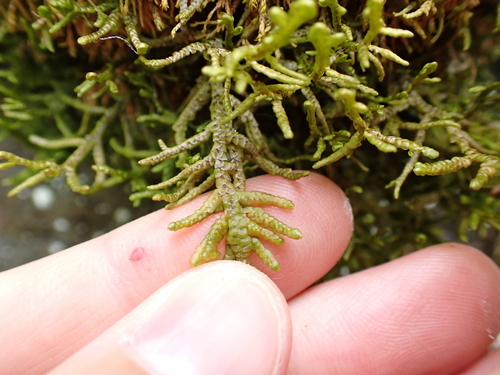
The Wall Scalewort is a small, flattened liverwort forming dense green mats. Its overlapping, scale-like leaves give it a textured appearance, often clinging tightly to vertical surfaces like old walls or tree bark, appearing darker green when wet.
Category
PlantsRarity
Common
Danger
1/5 · Very low
Snaps
2
It helps create mini-microclimates, keeping tiny creatures cool and moist under its leafy cover.
This tiny plant has no true roots! Instead, it uses tiny threads called rhizoids to anchor itself.
Unlike most plants, Wall Scalewort doesn't have flowers or seeds; it reproduces using microscopic spores!
Wall Scalewort is often called an 'epiphyte' when it grows on trees, using the tree for support, not food!
Wall Scalewort can attach firmly to rough surfaces like rocks and bark, helping it stay put even in windy conditions.
Wall Scalewort can absorb and hold a lot of water, which helps it survive dry spells in its habitat.
Wall Scalewort releases tiny spores that can travel by wind or water, helping it spread to new places.
Hypnum cupressiforme
Often grows alongside this moss on similar substrates.

Pleurozium schreberi
Shares habitat and sometimes grows interwoven.
Parmelia sulcata
Commonly found on the same tree bark or rocks.
This trait characterizes plants lacking specialized vascular tissues (xylem and phloem) for transporting water and nutrients.
Spore-producing organisms reproduce by releasing small, often single-celled, reproductive units called spores.
Describes a relationship between two different species where they live in close association, often benefiting one or both.
Describes organisms that break down dead organic material, recycling nutrients back into the ecosystem.

Describes a species whose presence and role have a disproportionately large effect on its environment.

Pertaining to species that are significantly smaller than typical or average for their kind.

This habitat trait indicates species that can coexist with humans in urban and suburban environments, utilizing man-made structures and green spaces.
No aliases listed yet.
Danger
1/5 · Very low
Always look but don't touch plants unless you know they are safe.
The easiest way to identify Wall Scalewort is to use the Snappit nature identifier app.
1-5 cm
5-15 cm
No
None
Perennial
Urban areas
Zoom in to split clusters and explore where this object has been snapped.
Aug 29, 2025
Lower Village DistrictPhoto attribution
(c) Steven Lamonde, some rights reserved (CC BY)
License: CC BY 4.0 ↗
Image may be shown cropped inside the card frame.
Take the discovery with you
Snap it with Snappit to identify it, learn what makes it special, and add the discovery to your collection.










.jpg&width=800)



_001.jpg&width=800)




