





Fir
Abies
Firs are tall trees with needle-like leaves that stay green all year. They provide homes for birds and small animals and smell wonderful, especially during the holidays.
Habitat: Forests
The Fir is a tall, conical evergreen tree with smooth, grey bark when young. It has distinctive flat, blunt-tipped needles that are soft to touch and often have two white stripes underneath. Its most unique feature is the upright cones, which grow like candles on the branches.
Category
TreesRarity
Common
Danger
1/5 · Very low
Snaps
Be the first to snap!
Crushing the needles of certain Fir trees can make them smell like bubblegum or citrus!
Fir trees are often used for making paper, lumber, and even musical instruments.
Some Fir species have bark blisters filled with a sticky, fragrant resin.
The oldest known Fir tree lived for over 700 years!
Fir has a perfect conical shape that helps heavy snow slide right off its branches, preventing damage in snowy habitats.
Fir cones grow straight up like candles and disintegrate on the branch, scattering their seeds widely without falling whole.
Fir has soft, flat needles that are well-adapted to photosynthesize efficiently in cold, dark forest environments.
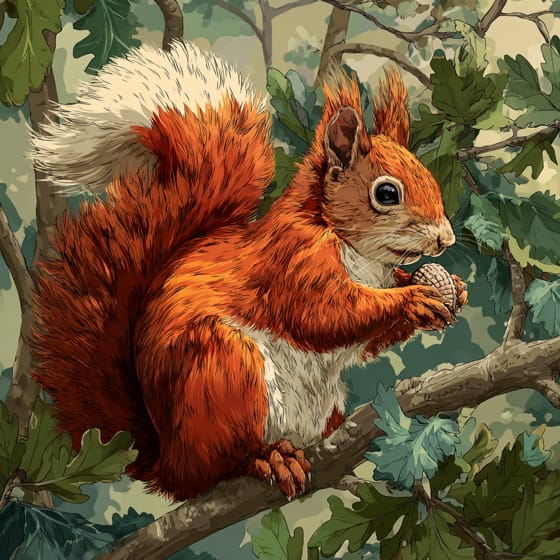
Tamiasciurus hudsonicus
Gathers and stores fir seeds
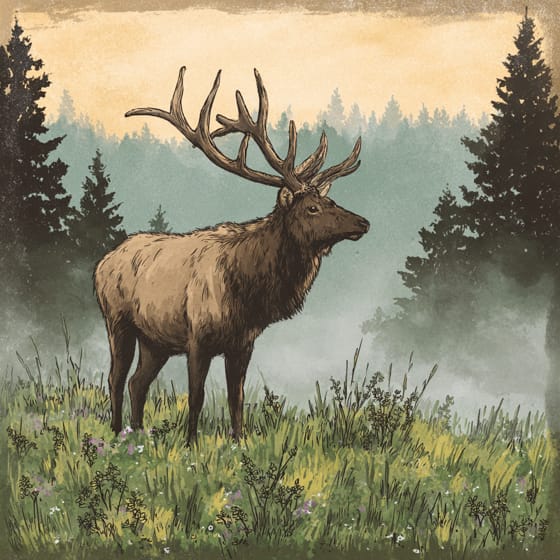
Cervus elaphus
Browses on fir needles and young shoots
Strix nebulosa
Often nests in large, mature fir trees
Russula emetica
Forms mycorrhizal association with fir roots
Cold hardy plants are able to withstand low temperatures and freezing conditions without significant damage.
Coniferous plants are typically evergreen, bearing needles or scales and reproductive cones.
Evergreen plants retain their foliage throughout the year, never shedding all their leaves at once.
Fragrant flowers emit a pleasant aroma, often to attract pollinators or for defense.

Timber refers to wood that has been prepared for use in building and carpentry.

Forest habitats are terrestrial environments dominated by dense tree cover, supporting a high diversity of plant and animal life.

This trait characterizes organisms with an exceptionally long lifespan compared to others of their kind.
Danger
1/5 · Very low
Enjoy looking at fir trees from a safe distance and avoid climbing them.
The easiest way to identify Fir is to use the Snappit nature identifier app.
10-80 m
4-12 m
No
50-250 cm
70-300 years
Forests
Cone
Zoom in to split clusters and explore where this object has been snapped.
Recent snaps will appear here as new observations are added.
Take the discovery with you
Snap it with Snappit to identify it, learn what makes it special, and add the discovery to your collection.











