

Fire Cherry
prunus pensylvanica
The Fire Cherry (Prunus pensylvanica), also known as the pin cherry, is a vibrant, fast-growing deciduous tree native to North America. Characterized by its rapid colonization of disturbed sites, this pioneer species often springs up in abundance after forest fires, logging operations, or land clearing—hence its fiery common name. It plays a critical ecological role in soil stabilization and early-successional forest development, preparing the ground for longer-lived species. Beyond its ecological utility, the Fire Cherry offers a beautiful seasonal display, from delicate clusters of white blossoms in early spring to bright red, translucent drupes in late summer.
Habitat: Found in recently disturbed areas, forest edges, burned sites, and clearings across temperate North America.
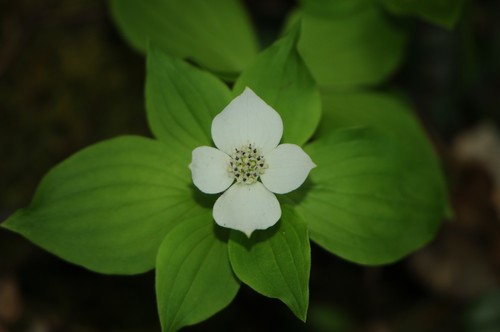
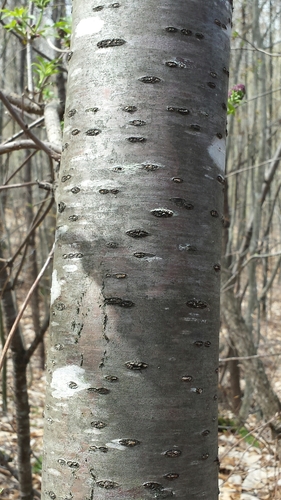
The Fire Cherry typically grows as a small tree or large shrub reaching 5 to 15 meters in height, featuring a narrow, rounded crown and slender, ascending branches. Its bark is thin, smooth, and reddish-brown, marked by prominent, horizontal orange-colored lenticels that become rough and fissured with age. The leaves are narrow, lance-shaped, finely serrated, and a shiny yellow-green, turning bright yellow or red in autumn. In spring, it produces small, star-like white flowers with five petals clustered in flat-topped umbels, which later mature into small, bright red, spherical cherries about 6 to 8 millimeters in diameter, suspended on long, thin stalks.
Category
PlantsRarity
Common
Danger
1/5 · Very low
Snaps
Be the first to snap!
A single fire cherry tree can produce thousands of seeds that can remain viable, buried deep in forest soil, for over 100 years waiting for sunlight.
Its wood is lightweight and close-grained, and while too small for heavy lumber, it is sometimes used for making high-quality tobacco pipes.
The common name 'Pin Cherry' comes from the way the tiny cherries sit at the end of long, slender stems, closely resembling pins stuck into a pin cushion.
Its seeds can lie dormant in the soil seed bank for up to a century, germinating rapidly when triggered by the heat and light of a forest fire.
It grows exceptionally fast in full sunlight, quickly establishing a canopy that stabilizes soil and prevents erosion in disturbed areas.
The leaves feature small extrafloral nectaries near the base of the blade that secrete sweet nectar, attracting ants and other predatory insects that defend the tree from herbivores.
As a photoautotrophic plant, the Fire Cherry synthesizes its own organic nutrients from sunlight, water, and carbon dioxide through photosynthesis.

Hyalophora cecropia
Caterpillars feed on the foliage of the tree, utilizing it as a vital larval host plant.

Bonasa umbellus
Feeds heavily on the ripe cherries during late summer and distributes the seeds in its droppings.
Ursus americanus
Feeds on the bark, twigs, and sweet cherries, often breaking branches to reach the fruit.
No trait badges are assigned for this object yet.
No aliases listed yet.
Collections for this object will appear here as more themes are added.
Danger
1/5 · Very low
No special safety notes yet.
Start with the whole plant, then compare leaf arrangement, leaf edges, stems and any flowers or fruit. Opposite leaves grow in pairs; alternate leaves come one at a time along the stem. These details tell you far more together than a single green leaf does. Plant Identifier: upload a photo and compare the visible details.
500-1500 cm
20-40 years
As a photoautotrophic plant, the Fire Cherry synthesizes its own organic nutrients from sunlight, water, and carbon dioxide through photosynthesis.
Found in recently disturbed areas, forest edges, burned sites, and clearings across temperate North America.
Zoom in to split clusters and explore where this object has been snapped.
Recent snaps will appear here as new observations are added.
Take the discovery with you
Snap it with Snappit to identify it, learn what makes it special, and add the discovery to your collection.