

Firecracker Plant
russelia equisetiformis
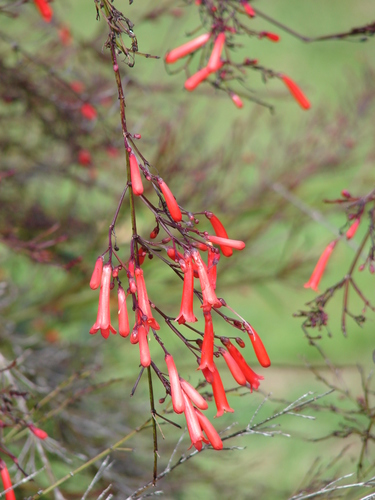
The Firecracker Plant (Russelia equisetiformis) is a stunning, perennial multi-branched subshrub native to Mexico. Famed for its striking weeping habit, this resilient plant features thin, rush-like green branches that cascade down gracefully, mimicking a biological fountain. From spring to winter, it is heavily adorned with clusters of bright red, tubular flowers that resemble small firecrackers, making it a spectacular visual addition to any landscape. Beyond its ornamental appeal, the Firecracker Plant is an ecological champion in warm climates. Its unique structure, which relies on photosynthetic stems rather than broad leaves, helps it conserve water efficiently. This adaptation allows it to thrive in rocky slopes, coastal gardens, and dry environments where other plants might struggle. It also plays a vital role in local ecosystems by serving as a high-value food source for nectar-seeking pollinators, particularly hummingbirds and butterflies.
Habitat: Typically found on dry, rocky slopes, cliffs, and in pine-oak forests within its native Mexican range, though widely naturalized in tropical coastal zones.
This plant is easily identified by its weeping, fountain-like structure of slender, bright green, wire-like stems that are virtually leafless, bearing only tiny, scale-like leaves. Hanging from these cascading branches are abundant, loose clusters of tubular, bright scarlet-red or coral flowers, each measuring about 2.5 centimeters in length. The shrub typically grows in dense, mounding clumps reaching 90 to 180 centimeters in height and spreading even wider.
Category
PlantsRarity
Common
Danger
1/5 · Very low
Snaps
Be the first to snap!
Despite having almost no true leaves, the plant is incredibly efficient at converting sunlight into energy via its specialized green stems.
In frost-free tropical climates, this plant can bloom continuously for 365 days a year, earning it the nickname Fountain Plant.
Its scientific name, 'equisetiformis', translates directly to 'horsetail-like', referencing its resemblance to prehistoric horsetail plants of the genus Equisetum.
It performs the vast majority of its photosynthesis through its green, rush-like stems, minimizing water loss by reducing leaf surface area to tiny scales.
Possesses a highly resilient root system and xerophytic adaptations that allow it to survive prolonged dry spells and nutrient-poor soils.
Produces vibrant, tubular red flowers specifically shaped and colored to attract hummingbirds, securing highly efficient pollination.
As a photosynthetic plant, it synthesizes its own organic compounds using sunlight, carbon dioxide, and water, supplemented by minerals absorbed through its roots.
Amazilia tzacatl
The plant provides vital nectar to this pollinator, which in turn helps fertilize the flowers.

Phoebis sennae
Butterflies visit the tubular blooms during the day to feed on nectar, assisting in pollination.
Aphis gossypii
Sapsucking insects that can occasionally infest the stems, extracting vital nutrients from the plant.
No trait badges are assigned for this object yet.
No aliases listed yet.
Collections for this object will appear here as more themes are added.
Danger
1/5 · Very low
No special safety notes yet.
Start with the whole plant, then compare leaf arrangement, leaf edges, stems and any flowers or fruit. Opposite leaves grow in pairs; alternate leaves come one at a time along the stem. These details tell you far more together than a single green leaf does. Plant Identifier: upload a photo and compare the visible details.
90-180 cm
5-15 years
As a photosynthetic plant, it synthesizes its own organic compounds using sunlight, carbon dioxide, and water, supplemented by minerals absorbed through its roots.
Typically found on dry, rocky slopes, cliffs, and in pine-oak forests within its native Mexican range, though widely naturalized in tropical coastal zones.
Zoom in to split clusters and explore where this object has been snapped.
Recent snaps will appear here as new observations are added.
Take the discovery with you
Snap it with Snappit to identify it, learn what makes it special, and add the discovery to your collection.