





Crescent-cup liverwort
Lunularia cruciata
The Crescent-cup liverwort is a small, green plant that grows close to the ground. It looks like tiny cups and loves to live in damp places like forests and gardens.
Habitat: Forests
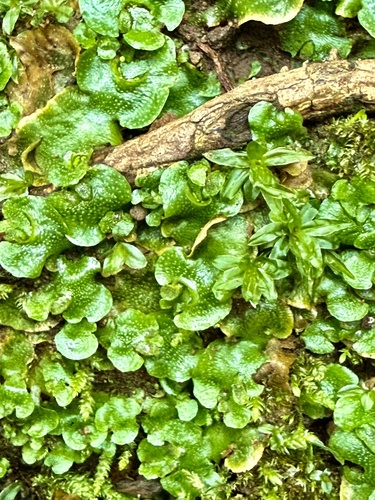
The Crescent-cup liverwort has a flat, ribbon-like body (thallus) that is bright to dark green and often shiny. It features distinctive crescent-shaped cups on its upper surface, which are crucial for its unique reproduction. These cups make it visually stand out from many other small ground-covering plants.
Category
PlantsRarity
Common
Danger
1/5 · Very low
Snaps
4
Crescent-cup liverwort is one of the oldest types of land plants on Earth!
It needs water for its male reproductive cells to swim and find female parts!
Its tiny 'gemmae' are like miniature clones, ready to sprout into new plants!
These fascinating plants can thrive in many places, even inside your greenhouse!
Crescent-cup liverwort has tiny gemma cups that splash out plantlets when raindrops hit them, spreading new plants!
It can absorb water directly through its entire surface, allowing it to thrive in damp places without true roots.
Crescent-cup liverwort has simple rhizoids (not true roots) that just help it anchor, letting it live on rocks or bark.

Arion ater
Slugs may graze on its moist thallus

Helix aspersa
Snails can consume parts of the liverwort
Folsomia candida
Provides microhabitat for small invertebrates
This trait characterizes plants lacking specialized vascular tissues (xylem and phloem) for transporting water and nutrients.
Shade tolerant plants are adapted to grow and thrive in areas with low light levels, requiring less direct sunlight.
Spore-producing organisms reproduce by releasing small, often single-celled, reproductive units called spores.
This trait signifies organisms belonging to a very old evolutionary group with ancestors dating back millions of years.

Describes organisms that break down dead organic material, recycling nutrients back into the ecosystem.

Forest habitats are terrestrial environments dominated by dense tree cover, supporting a high diversity of plant and animal life.

Pertaining to species that are significantly smaller than typical or average for their kind.
No aliases listed yet.
Danger
1/5 · Very low
Always look but don't touch plants unless you know they are safe.
The easiest way to identify Crescent-cup liverwort is to use the Snappit nature identifier app.
0.5-2 cm
1-5 cm
No
None
Perennial
Water
Forests
Zoom in to split clusters and explore where this object has been snapped.
Feb 20, 2026
El Sereno Open SpacePhoto attribution
no rights reserved
License: CC0 1.0 ↗
Image may be shown cropped inside the card frame.

California, US
You might spot Pipevine Swallowtail and Western Fence Lizard.
View guide →

California, US
You might spot Hoary Rock-Rose, Brittleleaf Manzanita, and Chaparral Pea.
View guide →

Oregon, US
You might spot Western Sword Fern, Duck, and Black-Tailed Bumble Bee.
View guide →

British Columbia, CA
You might spot Western Sword Fern, Douglas Fir, and Red Huckleberry.
View guide →

Oregon, US
You might spot Great White Shark, Blue Spotted Stingray, and Octopus.
View guide →
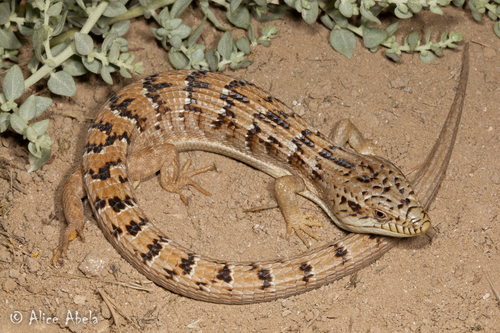
California, US
You might spot Southern Alligator Lizard, Grasses, and Catchweed Bedstraw.
View guide →
Take the discovery with you
Snap it with Snappit to identify it, learn what makes it special, and add the discovery to your collection.








.jpg&width=800)



_001.jpg&width=800)



