
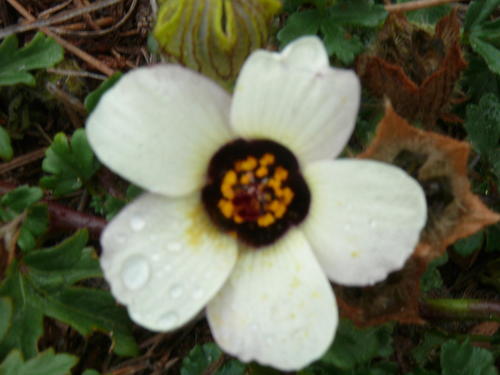


Flower-Of-An-Hour
hibiscus trionum
Flower-Of-An-Hour (Hibiscus trionum), also known as bladder ketmia, is a charming and ephemeral annual plant belonging to the mallow family. Native to the warm regions of the Old World, it has successfully naturalized across many temperate and tropical regions globally. It is famous for its fleeting floral display: individual flowers open mid-morning on sunny days and typically last for only a few hours before closing forever. Despite its brief bloom time, the plant produces numerous buds, ensuring a continuous succession of flowers over the summer. While often classified as an agricultural weed in cropland, gardeners often appreciate its striking, delicate blossoms and unusual papery seed pods. The plant thrives in disturbed soils, displaying a hardy resilience that allows it to flourish in conditions where other plants might struggle.
Habitat: Typically found in disturbed soils, agricultural fields, waste grounds, gardens, and along roadsides.
Flower-Of-An-Hour is a low-growing, branching herb reaching heights of 10 to 50 cm, with stems covered in rough, spreading hairs. Its leaves are deeply lobed into three to five coarse segments. The most distinctive feature is the blossom, which is roughly 3 to 5 cm wide with five cream-to-pale-yellow petals, each dramatically marked with a deep purple or burgundy center. Crucially, the flower is supported by a highly characteristic inflated, bladder-like green calyx with dark longitudinal veins, which puffs up and turns papery as the seeds mature inside.
Category
PlantsRarity
Common
Danger
1/5 · Very low
Snaps
Be the first to snap!
Despite being closely related to okra and culinary hibiscus, Hibiscus trionum is not typically consumed and is instead used strictly for ornamental or ecological purposes.
Its fleeting blooming window has earned it evocative names such as shoo-fly, hour-flower, and bladder ketmia across different regions.
The unique papery, balloon-like pods help disperse the plant's seeds; they can float on water currents or roll along the ground in high winds.
Flower blossoms open for only a few hours during peak morning sunlight, reducing water loss and limiting exposure to harsh afternoon heat.
The calyx swells into a protective, air-filled balloon around the developing seed pod, sheltering the seeds from predators and harsh weather.
The petals feature nanoscale ridges that diffract light, creating a blue halo effect visible to pollinating insects even under varying light conditions.
As a photoautotrophic plant, it produces glucose and essential organic molecules through photosynthesis, utilizing solar energy, water, carbon dioxide, and soil minerals.
Apis mellifera
Visiting the fleeting flowers for nectar and pollen, acting as a primary pollinator.
Niesthrea louisianica
Feeds heavily on the developing seeds and pods of the Hibiscus genus.
Helicoverpa armigera
Caterpillars feed on the leaves and stems of the plant, occasionally defoliating it.
No trait badges are assigned for this object yet.
No aliases listed yet.
Collections for this object will appear here as more themes are added.
Danger
1/5 · Very low
No special safety notes yet.
Start with the whole plant, then compare leaf arrangement, leaf edges, stems and any flowers or fruit. Opposite leaves grow in pairs; alternate leaves come one at a time along the stem. These details tell you far more together than a single green leaf does. Plant Identifier: upload a photo and compare the visible details.
10+ cm
1+ years
As a photoautotrophic plant, it produces glucose and essential organic molecules through photosynthesis, utilizing solar energy, water, carbon dioxide, and soil minerals.
Typically found in disturbed soils, agricultural fields, waste grounds, gardens, and along roadsides.
Zoom in to split clusters and explore where this object has been snapped.
Recent snaps will appear here as new observations are added.
Take the discovery with you
Snap it with Snappit to identify it, learn what makes it special, and add the discovery to your collection.


















