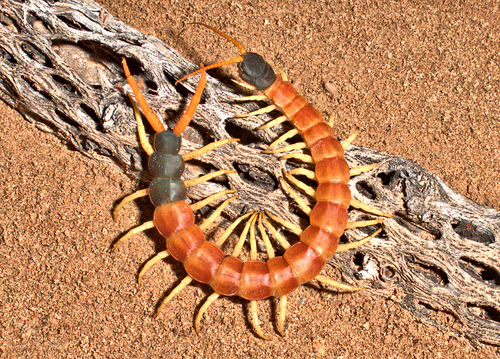


Giant Desert Centipede
scolopendra heros
The Giant Desert Centipede, also known as the Texas redheaded centipede, is one of North America's largest and most formidable terrestrial invertebrates. Native to the arid southwestern United States and northern Mexico, this striking predator is renowned for its impressive size and warning coloration. Growing up to eight inches long, it commands respect in its native ecosystem. Far from being a simple pest, this centipede is a highly efficient ecological predator that plays an important role in controlling populations of insect and small vertebrate species alike.
Habitat: Found in arid and semi-arid environments, particularly rocky hillsides, desert scrublands, and open pine-oak woodlands, where it hides under stones, rotten logs, or leaf litter.
This large, multi-segmented invertebrate typically reaches lengths of 16 to 20 centimeters. It exhibits striking aposematic coloration, featuring a brilliant orange-red head and first body segment, contrasted against a dark, shiny greenish-black body. Its long antennae and 21 pairs of legs are typically bright yellow or light orange. The modified first pair of legs, known as forcipules or toxicognaths, are large claw-like appendages curving under the head, used to inject venom into prey.
Category
AnimalRarity
Common
Danger
1/5 · Very low
Snaps
Be the first to snap!
Despite their name, centipedes never have exactly 100 legs; the Giant Desert Centipede specifically has 21 pairs (42 legs).
Mother centipedes are surprisingly nurturing, wrapping their bodies around their eggs and hatchlings to protect them from predators and fungi.
Their venom claws are actually highly modified front legs, not mouthparts, that evolved over millions of years to deliver paralyzing toxins.
Equipped with powerful modified front legs called toxicognaths that inject a potent cytolytic and neurotoxic venom, capable of quickly paralyzing insects and small vertebrates.
Employs highly contrasting, bright warning colors—such as red, yellow, and black—to signal its toxicity and deter potential predators.
Uses specialized sensory structures in its antennae and sensitive leg hairs to detect minute vibrations and navigate pitch-black crevices with extreme precision.
A highly aggressive predator that actively hunts insects, arachnids, and small vertebrates, including lizards, snakes, and small rodents.
Age differences: Juveniles feed primarily on small insects and soft-bodied invertebrates, whereas adults target larger prey, including small vertebrates.
Chaetodipus penicillatus
The centipede preys upon small nocturnal rodents, overpowering them with venom.

Geococcyx californianus
Roadrunners are swift predators that routinely hunt and consume large centipedes, managing to avoid their venomous bite.

Antrozous pallidus
Pallid bats forage on the ground and frequently prey upon large, venomous desert arthropods, including this centipede.
No trait badges are assigned for this object yet.
No aliases listed yet.
Collections for this object will appear here as more themes are added.
Danger
1/5 · Very low
No special safety notes yet.
Start with body shape, legs or fins, fur, feathers or scales, and standout markings. Then weigh size, habitat and where you saw it. Young animals and seasonal coats can look very different from familiar adults. Animal Identifier: upload a photo and compare the visible details.
16+ cm
0.01+ kg
3+ years
4 km/h
A highly aggressive predator that actively hunts insects, arachnids, and small vertebrates, including lizards, snakes, and small rodents.
Found in arid and semi-arid environments, particularly rocky hillsides, desert scrublands, and open pine-oak woodlands, where it hides under stones, rotten logs, or leaf litter.
Pursuit
Zoom in to split clusters and explore where this object has been snapped.
Recent snaps will appear here as new observations are added.
Take the discovery with you
Snap it with Snappit to identify it, learn what makes it special, and add the discovery to your collection.