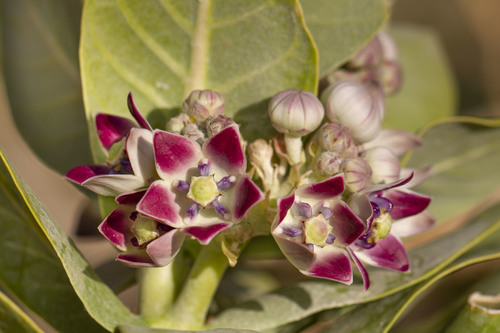


Giant Milkweed
calotropis procera
The Giant Milkweed (Calotropis procera) is an incredibly resilient, evergreen shrub or small tree native to arid and semi-arid regions of Africa, Asia, and the Middle East. Often recognized by its large, leathery grayish-green leaves and clusters of striking waxy flowers, this species plays a vital role in desert ecosystems. It is highly valued for its traditional medicinal uses, although almost every part of the plant contains a toxic white latex. This hardy plant is highly adapted to disturbed soils, dry environments, and saline conditions, often serving as a pioneer species that stabilizes sand dunes and provides vital resources for desert wildlife.
Habitat: Found in arid, semi-arid, and disturbed environments such as roadsides, overgrazed pastures, and coastal dunes.
This robust, multi-stemmed shrub typically grows up to 4 meters tall, featuring opposite, sessile, obovate-to-oblong leaves that are soft, leathery, and covered in a fine white down when young. The foliage has a distinctive dusty, pale-green or grayish hue. The striking flowers are bell-shaped and grow in clusters; they are white with deep purple or pinkish tips on the petals and a central purplish corona. The fruit is a large, inflated, mango-shaped pod that splits open when mature to release numerous brown seeds attached to silky white hairs.
Category
PlantsRarity
Common
Danger
1/5 · Very low
Snaps
Be the first to snap!
Despite its high toxicity, the desert locust can feed on its leaves and utilizes the toxins to protect itself from predators.
Its seeds are attached to silky, floss-like fibers that were once used as a substitute for cotton to stuff life jackets and pillows.
The toxic milky sap contains cardiac glycosides, which have historically been used on arrow tips for hunting.
Produces a thick, milky white sap rich in cardiac glycosides that deters most herbivores and pests from feeding on its tissues.
Utilizes deep taproots and succulent, waxy leaves to survive extreme heat and prolonged periods of drought with minimal water.
Produces seeds equipped with silky tufts of hair, allowing them to drift long distances on desert winds to colonize new areas.
As a photosynthetic plant, the Giant Milkweed produces its own energy using sunlight, carbon dioxide, and water.
Danaus chrysippus
The caterpillars of this butterfly feed exclusively on the toxic leaves, sequestering cardenolides for their own chemical defense.
Spilostethus pandurus
Feeds on the seeds and sap of the giant milkweed, tolerating and storing its toxic compounds.
No trait badges are assigned for this object yet.
Collections for this object will appear here as more themes are added.
Danger
1/5 · Very low
No special safety notes yet.
Start with the whole plant, then compare leaf arrangement, leaf edges, stems and any flowers or fruit. Opposite leaves grow in pairs; alternate leaves come one at a time along the stem. These details tell you far more together than a single green leaf does. Plant Identifier: upload a photo and compare the visible details.
150-400 cm
5-15 years
As a photosynthetic plant, the Giant Milkweed produces its own energy using sunlight, carbon dioxide, and water.
Found in arid, semi-arid, and disturbed environments such as roadsides, overgrazed pastures, and coastal dunes.
Zoom in to split clusters and explore where this object has been snapped.
Recent snaps will appear here as new observations are added.
Take the discovery with you
Snap it with Snappit to identify it, learn what makes it special, and add the discovery to your collection.