

Giant Peacock Moth
saturnia pyri
The Giant Peacock Moth (Saturnia pyri) is a magnificent insect and Europe's largest native moth, a true marvel of the natural world. Known for its impressive size and striking appearance, it spends the majority of its life as a large, green caterpillar before undergoing a remarkable transformation into a breathtaking winged adult. These moths are primarily nocturnal and serve as an important indicator of healthy, biodiverse ecosystems within their geographic range. Their imposing presence and beautiful markings make them a sought-after sight for nature enthusiasts.
Habitat: Found in open woodlands, traditional orchards, hedgerows, and along riverbanks, typically in areas with abundant host plants for its larval stage.
The adult Giant Peacock Moth is easily identified by its enormous wingspan, which can reach up to 20 cm. Its wings display an intricate mosaic of rich browns, greys, and creams, adorned with wavy lines and, most notably, prominent, dark-bordered 'eyespots' on each wing. These eyespots are reminiscent of a peacock's tail feathers, hence its common name. The moth possesses a stout, hairy body that typically matches the general coloration of its wings.
Category
InsectsRarity
Common
Danger
1/5 · Very low
Snaps
1
Adult Giant Peacock Moths do not possess functional mouths and therefore do not feed at all, relying entirely on energy reserves stored during their caterpillar phase to fuel their short reproductive lives.
Female Giant Peacock Moths can attract males from distances of up to 20 kilometers (12 miles) due to the incredibly powerful pheromones they release.
The caterpillar of this moth is notoriously large, bright green, and covered in blue, bristle-tipped tubercles, making it one of the most striking caterpillars in Europe.
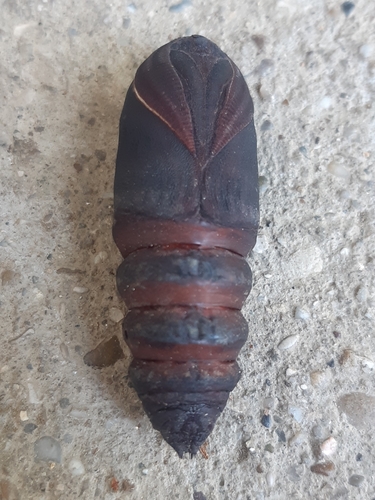
The pupa overwinters inside a tough, pear-shaped silken cocoon, which is typically expertly camouflaged among twigs or fallen leaves, providing protection through the colder months.
Female Giant Peacock Moths release potent pheromones that male moths can detect from several kilometers away, enabling them to locate mates efficiently even across vast distances.
The large, intimidating eyespots on the moth's wings are flashed when threatened, serving to startle potential predators such as birds and bats, thereby providing a crucial moment for escape.
Both the caterpillar and adult moth exhibit mottled coloration that allows them to blend seamlessly with their arboreal surroundings, providing highly effective camouflage against predators throughout their life cycle.
The larval stage of the Giant Peacock Moth is herbivorous, consuming large quantities of leaves from various trees and shrubs to store energy for metamorphosis. Adult moths, however, lack functional mouthparts and do not feed, relying solely on energy reserves accumulated during their caterpillar phase for reproduction.
Age differences: Larvae are active feeders on foliage, undergoing several instars, while adults are non-feeding and live solely on stored fat reserves for their short reproductive period.

Pyrus communis
Primary larval food source
Malus domestica
Primary larval food source

Parus major
Predation on larvae and pupae
Cuculus canorus
Predation on larvae
No trait badges are assigned for this object yet.
No aliases listed yet.
Collections for this object will appear here as more themes are added.
Danger
1/5 · Very low
No special safety notes yet.
Compare resting wing shape, forewing markings, antennae and body build. Small brown moths can hinge on fine details a phone photo can't always catch. Moth Identifier: upload a photo and compare the visible details.
4-6 cm
10-20 cm
0.005-0.015 kg
0-1 years
The larval stage of the Giant Peacock Moth is herbivorous, consuming large quantities of leaves from various trees and shrubs to store energy for metamorphosis. Adult moths, however, lack functional mouthparts and do not feed, relying solely on energy reserves accumulated during their caterpillar phase for reproduction.
Found in open woodlands, traditional orchards, hedgerows, and along riverbanks, typically in areas with abundant host plants for its larval stage.
Foraging (larvae)
Zoom in to split clusters and explore where this object has been snapped.
Take the discovery with you
Snap it with Snappit to identify it, learn what makes it special, and add the discovery to your collection.