


Giant White Wakerobin
trillium albidum
The Giant White Wakerobin, scientifically known as Trillium albidum, is an exquisite perennial wildflower native to the shaded woodlands of western North America. Flowering in early spring, this forest-dwelling gem heralds the end of winter with its striking, stalkless white blooms and beautifully mottled foliage. Unlike many other wildflowers, its petals rise directly from the center of a three-leaf whorl, filling the damp spring air with a sweet, rose-like fragrance. It plays a vital role in its native ecosystem, interacting with local ant populations for seed dispersal and providing early-season forage for herbivores. For plant enthusiasts and hikers, spotting a colony of these majestic trilliums blanketing a damp ravine is a classic and unforgettable Pacific Northwest experience.
Habitat: Found in moist, shaded coniferous and deciduous forests, damp ravines, and riparian canyons.
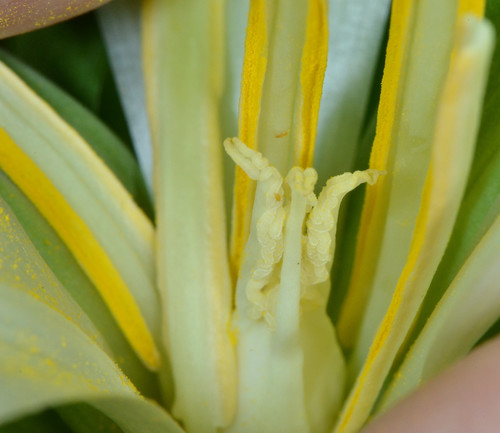
This robust perennial grows up to 70 centimeters tall and is easily identified by its structural symmetry. It features a single whorl of three large, broadly ovate green leaves, which are vividly mottled with dark green or bronze-purple patches. Resting directly on these leaves, without any supporting stalk, is a solitary flower composed of three erect, lance-shaped white to pale pink petals that can reach up to 11 centimeters in length. The center of the flower features prominent purple-purple stamens, surrounded by three green sepals that support the base.
Category
PlantsRarity
Common
Danger
1/5 · Very low
Snaps
Be the first to snap!
It can take up to seven to fifteen years for a seed-grown Giant White Wakerobin to produce its very first flower.
Picking the flower or leaves of this plant can easily kill it, as it prevents the underground rhizome from gathering enough energy to survive winter.
The entire plant strictly adheres to the rule of three, displaying three leaves, three sepals, and three petals.
Produces seeds equipped with lipid-rich structures called elaiosomes to attract ants, which carry and plant the seeds in their underground nests.
The dark, marble-patterned mottling on the leaves mimics decaying forest litter, helping to protect young shoots from hungry herbivores.
Emits a strong, sweet, rose-like scent that specifically attracts early-season beetles and flies for successful pollination.
As a photosynthesizing plant, it uses chlorophyll to convert sunlight, carbon dioxide, and water into sugars, while drawing essential minerals from moist organic soil.
Formica obscuripes
Ants gather the seeds to feed on the nutrient-rich elaiosomes, thereby dispersing and planting the seeds away from the parent plant.
Odocoileus hemionus
Deer frequently forage on the leaves and flowers, which can severely damage or kill the slow-growing plant.
No trait badges are assigned for this object yet.
No aliases listed yet.
Collections for this object will appear here as more themes are added.
Danger
1/5 · Very low
No special safety notes yet.
Start with the whole plant, then compare leaf arrangement, leaf edges, stems and any flowers or fruit. Opposite leaves grow in pairs; alternate leaves come one at a time along the stem. These details tell you far more together than a single green leaf does. Plant Identifier: upload a photo and compare the visible details.
20-70 cm
10-30 years
As a photosynthesizing plant, it uses chlorophyll to convert sunlight, carbon dioxide, and water into sugars, while drawing essential minerals from moist organic soil.
Found in moist, shaded coniferous and deciduous forests, damp ravines, and riparian canyons.
Zoom in to split clusters and explore where this object has been snapped.
Recent snaps will appear here as new observations are added.

Oregon, US
You might spot Rough-Skinned Newt and Pacific Banana Slug.
View guide →

Oregon, US
You might spot Great Camas, Columbian Larkspur, and Osoberry.
View guide →

Oregon, US
You might spot Pacific Trillium, Giant White Fawn Lily, and Candy Flower.
View guide →
Take the discovery with you
Snap it with Snappit to identify it, learn what makes it special, and add the discovery to your collection.

















