





bur oak
Quercus macrocarpa
The bur oak is a big tree with strong branches and large leaves. It can live for hundreds of years and provides homes for many animals. Its acorns are a tasty treat for squirrels and other critters!
Habitat: Forests
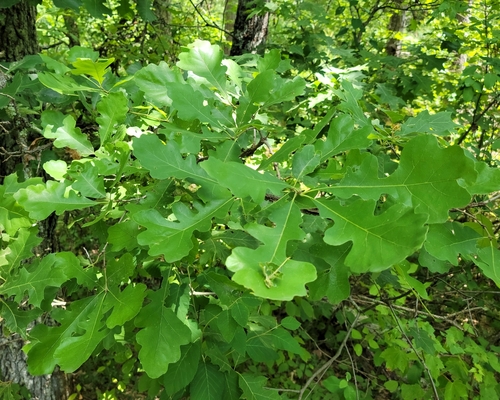
The bur oak has deeply furrowed, ridged bark that can resemble cork. Its leaves are distinctly lobed, with a narrow waist near the center. The most unique feature is its large acorn, often half-covered by a fringed, bur-like cup.
Category
PlantsRarity
Common
Danger
1/5 · Very low
Snaps
12
Bur oak trees can live for over 400 years, some even reaching 1000!
Its extra-large acorns often float, helping them spread far away by water!
Native Americans once used bur oak acorns to make flour for bread and other foods.
The fringed cap of a bur oak acorn looks like it's wearing a tiny, fuzzy hat!
Bur oak has super thick, furrowed bark that protects it like armor from wildfires, helping it survive.
Its huge acorns are packed with food, giving baby trees a big energy boost to grow and reproduce.
A long taproot helps bur oaks stand strong against high winds and find water deep underground to survive.
Bur oak can survive with its roots underwater for weeks, adapting to temporary floods for survival.
Deciduous plants periodically shed all their leaves, typically during autumn or dry seasons.
Broadleaf trees are angiosperms characterized by flat, wide leaves that are typically shed annually in temperate climates.
Cold hardy plants are able to withstand low temperatures and freezing conditions without significant damage.
Nut bearing plants produce hard-shelled fruits, commonly known as nuts, which contain a single seed and are a valuable food source.

Edible plants are those parts of a plant that are considered safe for human consumption.

Timber refers to wood that has been prepared for use in building and carpentry.

This trait signifies organisms belonging to a very old evolutionary group with ancestors dating back millions of years.

Forest habitats are terrestrial environments dominated by dense tree cover, supporting a high diversity of plant and animal life.

This trait characterizes organisms with an exceptionally long lifespan compared to others of their kind.

Describes a species whose presence and role have a disproportionately large effect on its environment.
No aliases listed yet.
Danger
1/5 · Very low
Stay away from the tree's branches and roots to avoid tripping or getting hurt.
The easiest way to identify bur oak is to use the Snappit nature identifier app.
2000-4000 cm
1500-3000 cm
Spring
No
Mild
Perennial
Wind
Zoom in to split clusters and explore where this object has been snapped.
Jul 2, 2023
Canoe Landing Prairie State Natural AreaPhoto attribution
(c) aarongunnar, some rights reserved (CC BY)
License: CC BY 4.0 ↗
Image may be shown cropped inside the card frame.

Ohio, US
You might spot Widow Skimmer, Eastern Pondhawk, and Bee.
View guide →

Indiana, US
You might spot Monarch, Black Swallowtail, and American Pokeweed.
View guide →

Missouri, US
You might spot Blackjack Oak, Bird's Foot Violet, and Starry Campion.
View guide →

South Dakota, US
You might spot Brittle Pricklypear and Eastern Redcedar.
View guide →

North Dakota, US
You might spot African Lion, Tiger, and Reticulated Giraffe.
View guide →

Tennessee, US
You might spot North American River Otter and Sand Tiger Shark.
View guide →
Take the discovery with you
Snap it with Snappit to identify it, learn what makes it special, and add the discovery to your collection.









.jpg&width=800)


_001.jpg&width=800)


