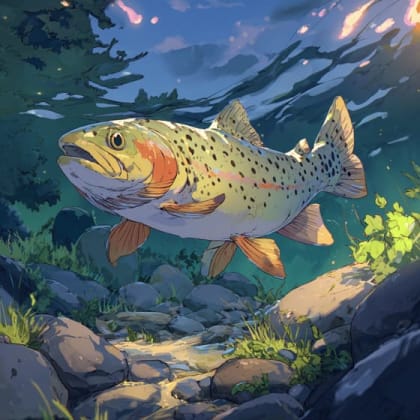
Giraffe Catfish
auchenoglanis occidentalis
The Giraffe Catfish has a long, spotted body that looks like a giraffe! It swims gracefully through rivers and lakes, making it a fun fish to watch.
Habitat: Freshwater rivers and lakes in Africa
The Giraffe Catfish has a distinct yellowish to brownish body covered in irregular dark brown spots, much like a giraffe's pattern. It features a broad, flattened head with small eyes and prominent whisker-like barbels around its mouth.
Category
FishRarity
Common
Danger
1/5 · Very low
Snaps
Be the first to snap!
Giraffe Catfish are important food for many people living near the rivers they call home!
Some Giraffe Catfish can make croaking sounds by rubbing their fins or bones together!
They belong to a very ancient fish family, with relatives swimming Earth's waters for ages!
When river oxygen drops, these fish gulp air from the surface to help them breathe!
Giraffe Catfish has long barbels that help them 'taste' and feel their surroundings to find food in dark or murky waters.
Giraffe Catfish can blend perfectly with dappled riverbeds thanks to their unique spot pattern, helping them hide from predators.
Giraffe Catfish can gulp air at the surface because of special modified gills, which helps them survive in low-oxygen water.
They eat a mix of tiny water creatures and bits of plants found on the riverbed.
Lates niloticus
Large fish sometimes prey on juvenile Giraffe Catfish.
Chironomus plumosus
They forage on these small invertebrates found in the riverbed.
Homo sapiens
This catfish is a popular and important food source for local communities.
Marked with spots or patches of a different color.
Social animals live in organized groups, cooperating for survival benefits such as foraging, defense, and raising offspring.
Filter feeders obtain nutrients by straining suspended food particles and small organisms from water.
This trait identifies organisms whose diet consists entirely or primarily of animal tissue.

Aquatic habitats encompass environments where organisms live predominantly in water, including oceans, rivers, lakes, and wetlands.
Danger
1/5 · Very low
No special safety notes yet.
The easiest way to identify Giraffe Catfish is to use the Snappit nature identifier app.
30-75 cm
0.5-4.5 kg
5-12 years
They eat a mix of tiny water creatures and bits of plants found on the riverbed.
8 km/h
Freshwater rivers and lakes in Africa
Foraging
Zoom in to split clusters and explore where this object has been snapped.
Recent snaps will appear here as new observations are added.
Take the discovery with you
Snap it with Snappit to identify it, learn what makes it special, and add the discovery to your collection.