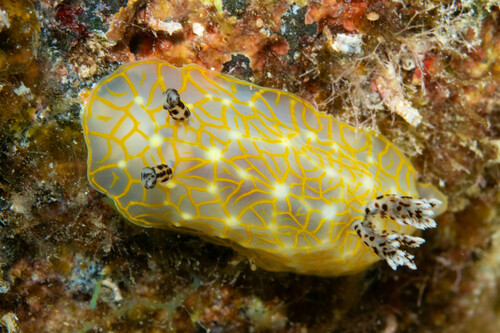


Gold Lace Nudibranch
halgerda terramtuentis
The Gold Lace Nudibranch (Halgerda terramtuentis) is a spectacular marine gastropod endemic to the waters of the Hawaiian Islands. This sea slug is highly celebrated among tidepoolers, snorkelers, and scuba divers for its exquisite, glass-like translucent white body covered in a network of raised, brilliant gold-colored ridges. It is typically found crawling slowly over shallow rocky reefs and inside dark crevices, ledges, or caves, where it searches for its preferred food source of marine sponges. Like other dorid nudibranchs, it lacks a protective shell in its adult form, relying instead on toxic chemical defenses sequestered from its diet to ward off potential predators. Observing this delicate creature navigate the underwater terrain is a true highlight for any marine enthusiast, showcasing the incredible and colorful biodiversity of tropical Pacific reef ecosystems.
Habitat: Found on shallow coral reefs, rocky ledges, and inside marine caves or crevices, primarily associated with sponge-rich substrates.
This nudibranch is easily identified by its firm, gelatinous, and translucent white-to-greyish body, which is highlighted by an intricate network of raised, golden-yellow ridges that form a lace-like pattern across its back. The intersections of these ridges often feature small, pointed tubercles. It possesses a pair of conspicuous, white rhinophores with black spots or lines near the tips, and a cluster of feathery, white and gold branchial gills located near the rear of its body. Adults typically reach a length of 2 to 5 centimeters, making them small but highly visible due to their bright coloration.
Category
InvertebrateRarity
Common
Danger
1/5 · Very low
Snaps
Be the first to snap!
Its scientific species name, 'terramtuentis', literally translates from Latin as 'earth-guarding' or 'looking at the earth', referencing the down-facing, attentive appearance of its sensory organs.
They lay their eggs in beautiful, coiled, rose-like ribbons made of jelly, which are carefully anchored to rocky substrates near their food supply.
Unlike many other nudibranchs which are soft and squishy, the Gold Lace Nudibranch has a surprisingly firm, rigid, and leathery texture due to tiny calcareous spicules embedded in its mantle.
Extracts toxic compounds from the sponges it consumes and stores them in its mantle tissues to deter predators.
Uses highly sensitive, scent-detecting tentacles on its head to locate food sources and mates in dark reef environments.
Capable of shedding portions of its mantle edge when threatened to distract predators while it makes a slow escape.
Feeds exclusively on specific species of marine sponges, utilizing a specialized radula to scrape away and digest the sponge tissue.
Mycale grandis
Feeds on this encrusting marine sponge, absorbing its chemical defenses.
Gymnodoris citrina
A predatory nudibranch that actively preys upon other sea slugs, including Halgerda species.
No trait badges are assigned for this object yet.
No aliases listed yet.
Collections for this object will appear here as more themes are added.
Danger
1/5 · Very low
No special safety notes yet.
Look for fins, arms, tentacles, shells and body symmetry. Underwater light shifts colors, so structure and markings usually matter more than shade. Sea Creature Identifier: upload a photo and compare the visible details.
2-5 cm
0.002-0.01 kg
1 years
Feeds exclusively on specific species of marine sponges, utilizing a specialized radula to scrape away and digest the sponge tissue.
Found on shallow coral reefs, rocky ledges, and inside marine caves or crevices, primarily associated with sponge-rich substrates.
Grazing
1000-10000
Zoom in to split clusters and explore where this object has been snapped.
Recent snaps will appear here as new observations are added.
Take the discovery with you
Snap it with Snappit to identify it, learn what makes it special, and add the discovery to your collection.