
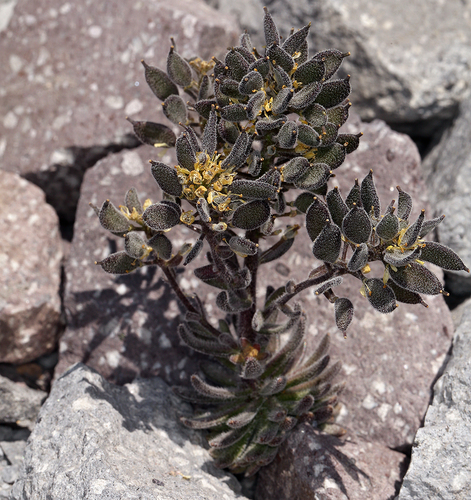


Golden Alpine Draba
draba aureola
Golden Alpine Draba (Draba aureola) is a hardy flowering plant native to the high-altitude regions of western North America. This small, perennial herb thrives in challenging alpine environments, showcasing remarkable adaptations to cold temperatures, strong winds, and nutrient-poor soils. Its bright yellow flowers provide a splash of color against rocky slopes and meadows, making it a distinctive feature of its high-mountain habitat. Ecologically, it plays a vital role in pioneering harsh terrains and providing nectar for alpine insects, contributing to the delicate balance of these extreme ecosystems.
Habitat: Found in rocky alpine slopes, scree fields, ridges, and open meadows at high elevations, often above the treeline.
The Golden Alpine Draba typically grows as a compact rosette of basal leaves, reaching a height of 5 to 20 centimeters. Its leaves are small, spatulate to oblanceolate, and often covered in fine hairs, giving them a grayish-green appearance. From the rosette, erect stems emerge, bearing clusters of vibrant yellow, four-petaled flowers at their tips. The flowers are relatively small, usually 4-7 mm wide, and grouped in a dense raceme, creating a striking golden display.
Category
PlantsRarity
Common
Danger
1/5 · Very low
Snaps
Be the first to snap!
As an alpine plant, it often grows in cushion-like forms to protect itself from strong winds and retain heat.
Its specific epithet "aureola" means "golden halo" in Latin, referring to its bright yellow flowers.
Some Draba species are among the fastest-flowering plants, capable of completing their life cycle in the very short alpine summer season.
The genus Draba is one of the most species-rich genera in the Brassicaceae family, with many species adapted to cold and alpine environments globally.
Its compact growth form and hairy leaves help it withstand extreme cold, strong winds, and intense UV radiation typical of alpine environments.
Despite a very short growing season, Draba aureola is capable of rapid growth and flowering, ensuring seed production before the return of winter.
Adaptations like deep root systems and efficient water retention allow it to survive periods of limited water availability in well-drained alpine soils.
Like all plants, the Golden Alpine Draba produces its own food through photosynthesis, utilizing sunlight, carbon dioxide from the air, and water and essential minerals absorbed from the soil.
Bombus alpinus
Pollination for reproduction.
Boloria chariclea
Source of nectar for adult insects.

Ochotona princeps
Grazing on leaves and flowers.

Glomeromycota (various species)
Enhances nutrient uptake from soil through symbiotic association.
No trait badges are assigned for this object yet.
No aliases listed yet.
Collections for this object will appear here as more themes are added.
Danger
1/5 · Very low
No special safety notes yet.
Start with the whole plant, then compare leaf arrangement, leaf edges, stems and any flowers or fruit. Opposite leaves grow in pairs; alternate leaves come one at a time along the stem. These details tell you far more together than a single green leaf does. Plant Identifier: upload a photo and compare the visible details.
5-20 cm
0.001-0.01 kg
1-5 years
Like all plants, the Golden Alpine Draba produces its own food through photosynthesis, utilizing sunlight, carbon dioxide from the air, and water and essential minerals absorbed from the soil.
Found in rocky alpine slopes, scree fields, ridges, and open meadows at high elevations, often above the treeline.
Photosynthesis And Nutrient Absorption
100-500
Zoom in to split clusters and explore where this object has been snapped.
Recent snaps will appear here as new observations are added.
Take the discovery with you
Snap it with Snappit to identify it, learn what makes it special, and add the discovery to your collection.


















