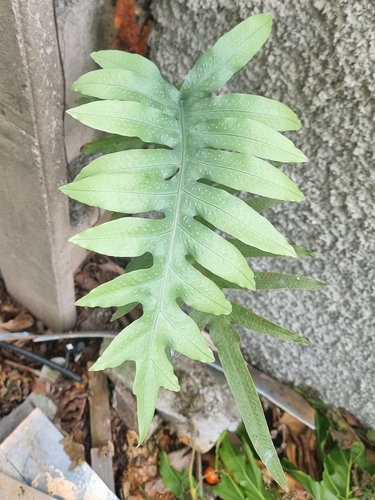


Golden Polypody
phlebodium aureum
The Golden Polypody (Phlebodium aureum), also known as Hare's Foot Fern, is a captivating and robust fern species native to tropical and subtropical regions of the Americas. Renowned for its distinctive fronds and vibrant blue-green hue, it often grows as an epiphyte, anchoring itself to trees and deriving moisture and nutrients from the air and accumulating organic matter rather than soil. Its unique growth habit and striking appearance make it a fascinating subject for both botanists and nature enthusiasts. This fern plays a vital role in its ecosystem by contributing to the understory vegetation and providing microhabitats for various small organisms.
Habitat: The Golden Polypody is typically found in humid, tropical, and subtropical forests, often growing epiphytically on tree trunks, branches, and rock crevices, or occasionally terrestrially in rich organic soil.
This fern is easily identified by its deeply lobed, often undulate fronds that exhibit a striking glaucous blue-green color, sometimes with a yellowish or golden tint, especially on younger growth. The fronds can reach lengths of 30 to 100 centimeters, arching gracefully. The undersides of the fronds host distinct, rounded, golden-yellow sori (spore-producing structures) arranged in rows, which give the fern its common name 'Golden Polypody'. Its thick, creeping, fuzzy rhizomes, often covered in golden-brown scales, are visible at the base and resemble a rabbit's or hare's foot.
Category
PlantsRarity
Common
Danger
1/5 · Very low
Snaps
1
Despite its preference for humidity, its waxy fronds and thick rhizomes make it surprisingly tolerant of drier conditions than many other ferns.
Golden Polypody is known to absorb certain airborne pollutants, contributing to improved indoor air quality, making it a popular choice for homes and offices.
In traditional medicine, it has been used for its purported diuretic and anti-inflammatory properties.
The fuzzy rhizomes that creep along the surface give it the common names 'Hare's Foot Fern' or 'Rabbit's Foot Fern', as they are said to resemble furry animal paws.
This fern is adapted to grow on other plants, primarily trees, without being parasitic. It uses its host for physical support, positioning itself to capture more sunlight and absorb moisture and nutrients from rain and decaying organic debris in the canopy.
The Golden Polypody possesses adaptations, such as its thick cuticle and ability to curl its fronds, that allow it to withstand periods of drought. Its scaly rhizomes also help in water retention and protection.
As a fern, it reproduces via spores rather than seeds. These microscopic spores are released from the golden sori on the undersides of its fronds, dispersing by wind to colonize new areas and perpetuate the species.
As a photosynthetic plant, the Golden Polypody produces its own food by converting sunlight, water, and carbon dioxide into sugars. It also absorbs essential mineral nutrients from its environment, particularly from accumulated organic matter.

Quercus virginiana
Provides a surface for epiphytic growth, allowing the fern to access light and moisture in the canopy.
Various species
Decomposition of organic matter around the fern's rhizomes releases nutrients that the fern can absorb.
Various species (e.g., spiders, insects)
The dense fronds and rhizomes create sheltered microhabitats.
No trait badges are assigned for this object yet.
No aliases listed yet.
Collections for this object will appear here as more themes are added.
Danger
1/5 · Very low
No special safety notes yet.
Compare frond shape, how the leaflets are arranged, the stalk, and any spore clusters you can see. A single detached leaflet often hides the plant's overall growth pattern. Fern Identifier: upload a photo and compare the visible details.
30-100 cm
0.1-0.5 kg
10-20 years
As a photosynthetic plant, the Golden Polypody produces its own food by converting sunlight, water, and carbon dioxide into sugars. It also absorbs essential mineral nutrients from its environment, particularly from accumulated organic matter.
The Golden Polypody is typically found in humid, tropical, and subtropical forests, often growing epiphytically on tree trunks, branches, and rock crevices, or occasionally terrestrially in rich organic soil.
Photosynthesis And Nutrient Absorption
Zoom in to split clusters and explore where this object has been snapped.

Florida, US
You might spot Atala, Monarch, and Brown Anole.
View guide →

Hawaii, US
You might spot Koster's Curse and White-Rumped Shama.
View guide →

Hawaii, US
You might spot Rough Maidenhair Fern, Coralberry, and Kahili Ginger.
View guide →
Take the discovery with you
Snap it with Snappit to identify it, learn what makes it special, and add the discovery to your collection.