
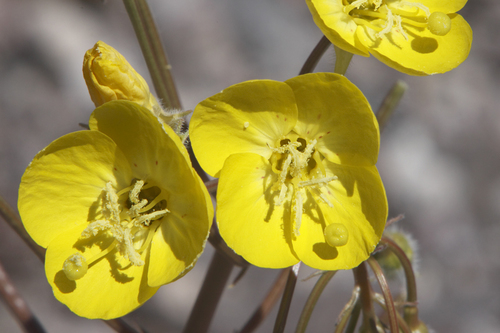


Golden Suncup
chylismia brevipes
The Golden Suncup (Chylismia brevipes), also known as the Mojave suncup, is a striking desert annual that paints the arid landscapes of Western North America with brilliant splashes of gold. Emerging after winter rains, this resilient wildflower is a vital early-season resource for desert pollinators. Its bright, cup-shaped flowers open in the evening and remain open through the morning, capturing the precious desert sunlight. This species is famous for its dramatic mass blooms, often referred to as 'superblooms', which can transform barren, gravelly desert washes and flats into sea-like expanses of vibrant yellow. Observing a golden suncup in its harsh, dry environment highlights the incredible adaptability of desert flora, showing how life can thrive in seemingly inhospitable conditions.
Habitat: Found on sandy or gravelly slopes, flats, and desert washes, primarily within the Mojave and Sonoran deserts.
This delicate annual herb typically grows from 10 to 80 centimeters tall, featuring a mainly basal rosette of leaves that are often tinged with purple or red spots along their veins. The flowers are arranged in a loose, terminal cluster atop slender, reddish stems. Each flower is characterized by four bright yellow petals, measuring about 3 to 15 millimeters long, which surround a prominent green stigma and bright yellow anthers. Frequently, the petals have small, reddish dots near their bases. The seed pods are long, slender, and cylindrical, spreading outwards from the stem as they mature.
Category
PlantsRarity
Common
Danger
1/5 · Very low
Snaps
Be the first to snap!
Despite being a desert plant, Golden Suncup seeds can remain viable in the dry desert soil for several years, waiting for the perfect sequence of winter rains to trigger a mass bloom.
Its scientific genus name, Chylismia, comes from the Greek word for 'juice' or 'infusion,' while the species name brevipes translates to 'short-footed,' referring to its short flower stalks.
The red spots on the petals are not just decorative; they function as nectar guides, directing pollinating insects to the center of the flower.
The plant remains dormant as a seed during drought periods, germinating rapidly after winter rains to complete its entire lifecycle before the summer heat intensifies.
Its flowers and leaves display heliotropism, tracking the sun to maximize light absorption for photosynthesis and maintain optimal flower temperatures.
The purple-red spotting on its leaves contains anthocyanins, which protect the plant's delicate tissues from intense ultraviolet radiation.
As a photoautotrophic plant, the Golden Suncup manufactures its own energy by absorbing sunlight, water, carbon dioxide, and essential soil minerals.
Andrena linsleyi
Specialist desert bees rely heavily on the pollen of the Golden Suncup to feed their larvae, assisting in the plant's pollination in return.

Gopherus agassizii
The desert tortoise grazes on various ephemeral desert annuals, including the leaves and flowers of the Golden Suncup, during the spring wet season.

Hyles lineata
Caterpillars of the white-lined sphinx moth feed on the foliage of plants in the Onagraceae family, including the Golden Suncup.
No trait badges are assigned for this object yet.
No aliases listed yet.
Collections for this object will appear here as more themes are added.
Danger
1/5 · Very low
No special safety notes yet.
Start with the whole plant, then compare leaf arrangement, leaf edges, stems and any flowers or fruit. Opposite leaves grow in pairs; alternate leaves come one at a time along the stem. These details tell you far more together than a single green leaf does. Plant Identifier: upload a photo and compare the visible details.
10-80 cm
up to 1 years
As a photoautotrophic plant, the Golden Suncup manufactures its own energy by absorbing sunlight, water, carbon dioxide, and essential soil minerals.
Found on sandy or gravelly slopes, flats, and desert washes, primarily within the Mojave and Sonoran deserts.
Photosynthesis
Zoom in to split clusters and explore where this object has been snapped.
Recent snaps will appear here as new observations are added.
Take the discovery with you
Snap it with Snappit to identify it, learn what makes it special, and add the discovery to your collection.

















