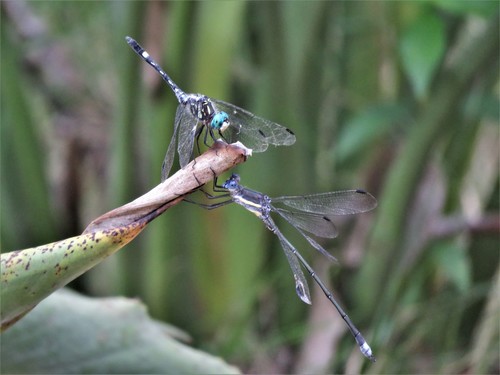


Great Spreadwing
archilestes grandis
The Great Spreadwing (Archilestes grandis) is a spectacular and exceptionally large damselfly native to North America. Distinguished by its remarkable size and elegant posture, this insect belongs to the spreadwing family (Lestidae), which is famous for resting with wings outstretched rather than folded. Historically native to the southwestern United States and Mexico, it has undergone a dramatic northward and eastward range expansion over the past century, thriving in human-altered wetland habitats. As a crucial component of freshwater ecosystems, the Great Spreadwing acts as both an effective predator of smaller insects and an indicator of wetland health. Observing this striking aerial acrobat perched on a sunlit twig near a slow-moving stream is a highlight for any nature enthusiast.
Habitat: Found near slow-moving streams, shaded ponds, and marshy ditches, typically perching on overhanging woody vegetation.
This species is easily recognized as the largest damselfly in North America, reaching lengths of 5 to 6 centimeters. It features a metallic bronze-to-green thorax highlighted by a prominent pale yellow stripe on each side. Its long, slender abdomen is dark grey to dull black, ending in pale claspers in males. True to its name, it rests with its clear, heavily veined wings held wide open at a 45-degree angle, exposing a prominent dark stigma near the tip of each wing.
Category
InsectsRarity
Common
Danger
1/5 · Very low
Snaps
Be the first to snap!
Egg-laying females often leave visible scars on the twigs of overhanging trees where they have deposited their eggs.
It is the largest damselfly species in North America, so large that beginners often mistake it for a dragonfly.
Its historical range was limited to the southwest, but it has staged a massive continent-wide expansion over the last century due to human pond creation.
Holds its wings out at a 45-degree angle while resting, which helps it warm up its flight muscles more rapidly in cool morning air.
Possesses incredible flight maneuverability, allowing it to hover, fly backward, and snatch flying prey directly out of mid-air.
Equipped with a sharp, saw-like ovipositor that allows females to cut into tough woody twigs to deposit eggs safely away from aquatic predators.
Both the aquatic nymphs and aerial adults are opportunistic insect predators, feeding on a wide variety of smaller insects and larvae.
Age differences: Nymphs develop underwater and feed heavily on aquatic larvae, while the adult stage is entirely terrestrial and preys on flying insects.
Culex pipiens
Feeds on adult mosquitoes in flight, helping control local pest populations.

Lithobates clamitans
Adult spreadwings are frequently caught and consumed by frogs resting along stream banks.

Salix nigra
Females frequently lay their eggs inside the living bark of willow branches hanging over water.
No trait badges are assigned for this object yet.
No aliases listed yet.
Collections for this object will appear here as more themes are added.
Danger
1/5 · Very low
No special safety notes yet.
Compare wing shape and resting posture, where the eyes sit, body markings and the tail segments. Males and females can look very different in color. Dragonfly Identifier: upload a photo and compare the visible details.
5+ cm
5+ cm
0.0001+ kg
1+ years
15 km/h
Both the aquatic nymphs and aerial adults are opportunistic insect predators, feeding on a wide variety of smaller insects and larvae.
Found near slow-moving streams, shaded ponds, and marshy ditches, typically perching on overhanging woody vegetation.
Zoom in to split clusters and explore where this object has been snapped.
Recent snaps will appear here as new observations are added.

Colorado, US
You might spot Eastern Fox Squirrel, Bee, and Duck.
View guide →

Colorado, US
You might spot Bee, Great Spreadwing, and Duck.
View guide →

Colorado, US
You might spot Eastern Fox Squirrel, Bee, and Canada Goose.
View guide →
Take the discovery with you
Snap it with Snappit to identify it, learn what makes it special, and add the discovery to your collection.