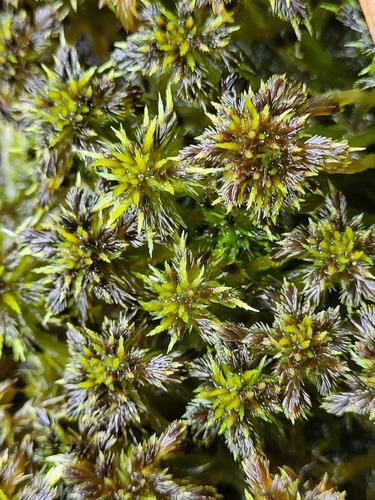


Greater Peatmoss
sphagnum majus
Greater Peatmoss (Sphagnum majus) is a remarkable, moisture-loving bryophyte that plays a critical role in shaping wetland ecosystems. Found predominantly in the wet hollows and acidic pools of northern bogs and fens, this robust moss forms dense, plush carpets of olive-green to brownish foliage. Unlike most plants, it thrives in nutrient-poor environments by actively engineering its surroundings, releasing hydrogen ions to acidify the water and suppress competing vegetation. This biological manipulation allows it to dominate vast peatland landscapes. Beyond its ecological dominance, Greater Peatmoss is a key player in global climate regulation. By creating waterlogged, anaerobic conditions, it prevents the decay of organic material, trapping immense amounts of carbon in the peat beneath it. This makes it an invaluable natural resource for carbon sequestration and a fascinating subject for nature enthusiasts exploring northern wetlands.
Habitat: Found in very wet, acidic peatlands, bogs, and poor fens, typically submerged or floating in shallow pools and wet hollows.
Greater Peatmoss is characterized by its relatively large, robust stature and a distinctive coloration that ranges from pale olive-green to warm brownish-green. It forms loose to dense carpets in very wet depressions. Individual plants feature a main stem adorned with clusters of branches; the spreading branches are often noticeably curved or sickle-shaped. The leaves on both the stem and branches are lanceolate-ovate, terminating in a narrow point. Under a magnifying lens, the leaves reveal a beautiful mesh-like pattern composed of green chlorophyll-containing cells surrounding large, transparent water-storage cells.
Category
PlantsRarity
Common
Danger
1/5 · Very low
Snaps
4
Because of its highly acidic and anaerobic growing conditions, peatlands dominated by this moss preserve organic matter, including ancient human bodies, for thousands of years.
During World War I, related Sphagnum species were widely harvested and used as sterile surgical dressings due to their natural antimicrobial properties.
Sphagnum majus can absorb up to 20 times its dry weight in water due to specialized hollow cells called hyaline cells.
Possesses large, empty hyaline cells with pore openings that can absorb and retain water up to twenty times the dry weight of the plant.
Actively exchanges hydrogen ions for dissolved mineral cations in the surrounding water, lowering the pH to suppress competitors.
Creates highly acidic, anaerobic conditions that severely delay organic decomposition, trapping carbon in accumulated peat for centuries.
As a photosynthetic bryophyte, it produces its own organic nutrients using sunlight, carbon dioxide, and water while absorbing trace minerals directly from its watery surroundings.

Drosera rotundifolia
Provides an acidic, moisture-rich substrate that supports the growth of carnivorous plants.
Sphagnum fuscum
Competes directly for space, sunlight, and nutrients in bog hollows and lawns.
No trait badges are assigned for this object yet.
No aliases listed yet.
Collections for this object will appear here as more themes are added.
Danger
1/5 · Very low
No special safety notes yet.
The easiest way to identify Greater Peatmoss is to use the Snappit nature identifier app.
10-30 cm
As a photosynthetic bryophyte, it produces its own organic nutrients using sunlight, carbon dioxide, and water while absorbing trace minerals directly from its watery surroundings.
Found in very wet, acidic peatlands, bogs, and poor fens, typically submerged or floating in shallow pools and wet hollows.
Zoom in to split clusters and explore where this object has been snapped.
Take the discovery with you
Snap it with Snappit to identify it, learn what makes it special, and add the discovery to your collection.












.jpg&width=800)



_001.jpg&width=800)




