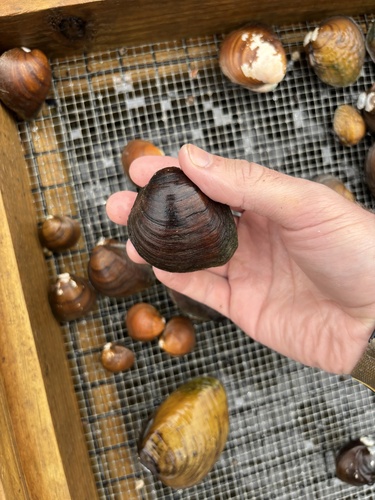


Gulf Pigtoe
fusconaia cerina
The Gulf Pigtoe (Fusconaia cerina) is a small but robust freshwater mussel native to the river systems of the American Gulf Coast. Like many freshwater bivalves, it is an ecosystem engineer that constantly filters water to feed on microscopic particles, quietly improving the water quality of its aquatic home. With its thick, somewhat triangular shell, this unassuming invertebrate rests partially buried in the riverbed, often forming dense beds alongside other native mussel species. Its fascinating life cycle relies entirely on a complex relationship with local fish species, which serve as temporary hosts for its microscopic larvae. While it may look like a simple rock to the untrained eye, the Gulf Pigtoe is a crucial indicator of river health, being highly sensitive to pollution and changes in water flow.
Habitat: Typically found in the flowing waters of creeks, streams, and medium-sized rivers with stable sand, gravel, or cobble substrates.
The Gulf Pigtoe has a relatively small, solid shell that is roughly triangular or sub-quadrate in shape, typically measuring between 3 and 6 centimeters in length. The exterior (periostracum) ranges in color from yellowish-brown to a rich chestnut brown, while younger individuals may display faint, subtle green rays radiating across the shell. The inner shell surface (nacre) is smooth and generally pearly white, occasionally flashing a delicate salmon or pinkish hue. The beak (umbo) at the top of the shell is prominent and slightly elevated above the hinge line, giving the mussel a chunky, wedge-like profile.
Category
InvertebrateRarity
Common
Danger
1/5 · Very low
Snaps
Be the first to snap!
A single adult freshwater mussel can filter up to 15 gallons of water per day, playing a massive role in keeping aquatic ecosystems clear and healthy.
Because their larvae must hitch a ride on fish to survive, a human-made dam blocking fish movement can inadvertently wipe out entire upstream mussel populations over time.
Despite lacking conventional eyes, freshwater mussels like the Gulf Pigtoe can sense changes in light and shadows to detect approaching predators.
The growth rings on a Gulf Pigtoe's shell can be counted much like tree rings to accurately estimate the mussel's age.
By constantly siphoning and filtering river water for microscopic food, these mussels act as natural water purifiers, significantly improving water clarity and quality.
Their microscopic larvae, called glochidia, temporarily attach to the gills of specific host fish, allowing this otherwise stationary species to safely disperse upstream.
Utilizing a strong, muscular foot, the mussel can burrow into and anchor itself firmly within gravel or sand substrates to withstand strong river currents.
As a benthic filter feeder, the Gulf Pigtoe continuously siphons river water to extract suspended microscopic organic matter for sustenance.
Age differences: Glochidia (larvae) absorb nutrients directly from the blood or tissue fluid of their host fish before dropping off and metamorphosing into independent, filter-feeding juveniles.
Cyprinella venusta
The mussel's larvae (glochidia) attach to the gills of the Blacktail Shiner to develop and disperse to new habitats.

Ondatra zibethicus
Muskrats are known mammalian predators of freshwater mussels, cracking their shells to consume the soft tissue inside.
Pleurobema georgianum
Competes for space and food resources in the same gravel beds with other native freshwater mussels.
No trait badges are assigned for this object yet.
No aliases listed yet.
Collections for this object will appear here as more themes are added.
Danger
1/5 · Very low
No special safety notes yet.
Compare body symmetry, shells, segments, legs, tentacles and how the animal moves. Invertebrates span many unrelated groups, so start with body structure. Invertebrate Identifier: upload a photo and compare the visible details.
3-7 cm
0.01-0.05 kg
10-30 years
As a benthic filter feeder, the Gulf Pigtoe continuously siphons river water to extract suspended microscopic organic matter for sustenance.
Typically found in the flowing waters of creeks, streams, and medium-sized rivers with stable sand, gravel, or cobble substrates.
Filtering
10000-80000
Zoom in to split clusters and explore where this object has been snapped.
Recent snaps will appear here as new observations are added.
Take the discovery with you
Snap it with Snappit to identify it, learn what makes it special, and add the discovery to your collection.