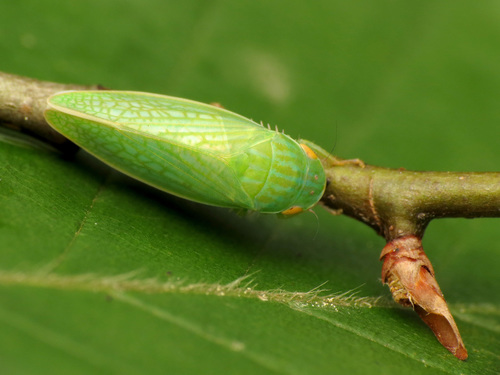





Gyponana
gyponana
Members of the genus Gyponana, commonly known as green leafhoppers, are fascinating and abundant insects within the family Cicadellidae. These small, wedge-shaped creatures are highly adapted to life among foliage, where they spend their days feeding on plant sap. Characterized by their pale green coloration, which provides excellent camouflage against leaves, they are a common sight in gardens, forests, and fields across North America. Despite their small size, Gyponana leafhoppers play a significant role in their ecosystems, acting as both consumers of plant juices and vital food sources for various predatory insects, birds, and spiders. Their remarkable jumping ability and complex vibrational communication methods make them a marvel of evolutionary adaptation, captivating entomologists and backyard nature observers alike.
Habitat: Typically found in temperate forests, shrublands, and domestic gardens, where they rest on the undersides of leaves of various deciduous trees and herbaceous plants.
Gyponana leafhoppers are characterized by their elongated, wedge-shaped bodies, typically measuring between 1 to 2 centimeters in length. They are primarily pale green to yellowish-green, allowing them to blend seamlessly with host leaves. Their broad, flat heads have small eyes that sometimes display a subtle reddish tint. Depending on the species, some individuals may feature faint, lengthwise orange or reddish stripes running down their pronotum. When at rest, their wings are held roof-like over their abdomen, forming a clean, aerodynamic silhouette.
Category
InsectsRarity
Common
Danger
1/5 · Very low
Snaps
Be the first to snap!
The brochosome coating they secrete is so structurally unique that scientists are studying it to develop advanced anti-reflective and water-resistant materials.
They are sometimes called sharpshooters because they actively flick away droplets of waste fluid, known as honeydew, to avoid attracting predators.
They can jump up to 100 times their body length in a single leap, generating forces that would cause a human to black out.
These leafhoppers produce microscopic, hollow protein-lipid spheres called brochosomes, which they rub over their bodies to create a highly water-repellent and self-cleaning protective layer.
Using specialized hind legs equipped with a catapult mechanism, they can launch themselves into the air at incredible speeds to escape predators in milliseconds.
Rather than using airborne sounds like cicadas, they communicate with potential mates by sending low-frequency vibrations through the stems and leaves of their host plants.
Gyponana leafhoppers feed strictly on plant fluids, using their specialized piercing-sucking mouthparts to tap into the vascular systems of host plants.
Age differences: Nymphs and adults feed on the same plant fluids, though nymphs target younger, softer plant tissue.

Quercus alba
Feeds on the leaves and sap of the host tree.
Chrysoperla carnea
Pours over foliage to hunt and consume leafhopper nymphs and adults.
Gonatopus ashmeadi
Infects and parasitizes leafhopper nymphs, eventually killing them.
Furry describes animals possessing a dense covering of soft hair or fur.
Social animals live in organized groups, cooperating for survival benefits such as foraging, defense, and raising offspring.
Arboreal animals live primarily in trees, utilizing them for shelter, food, and protection from predators.
This trait characterizes organisms whose diet consists entirely or primarily of plant material.
Diurnal animals are primarily active during daylight hours, typically resting or sleeping at night.
Collections for this object will appear here as more themes are added.
Danger
1/5 · Very low
No special safety notes yet.
Look for six legs, antennae, three body sections and the shape of the wings. Beetles have hardened front wings; flies have just one working pair. Tiny insects may need a close view before their group is clear. Insect Identifier: upload a photo and compare the visible details.
1-2 cm
1-2 cm
0.00001-0.00003 kg
1 years
Gyponana leafhoppers feed strictly on plant fluids, using their specialized piercing-sucking mouthparts to tap into the vascular systems of host plants.
Typically found in temperate forests, shrublands, and domestic gardens, where they rest on the undersides of leaves of various deciduous trees and herbaceous plants.
Grazing
Zoom in to split clusters and explore where this object has been snapped.
Recent snaps will appear here as new observations are added.
Take the discovery with you
Snap it with Snappit to identify it, learn what makes it special, and add the discovery to your collection.