


Hairy Crabweed
fatoua villosa
Hairy Crabweed (Fatoua villosa) is a fast-growing, opportunistic annual herb that has become a notorious weed across many parts of the world outside its native East Asian habitat. A member of the mulberry family (Moraceae), it thrives in disturbed soils, cultivated gardens, and commercial greenhouses, where it often hitchhikes undetected in the soil of nursery stock. Because of its rapid growth cycle and highly efficient reproductive strategies, it can quickly colonize empty spaces, making it a persistent headache for gardeners and agriculturalists. Despite its classification as an unwanted weed, Hairy Crabweed is a fascinating example of botanical adaptability. It has evolved to complete its life cycle in just a few short weeks, ensuring that even temporary patches of moisture and light are enough for it to produce another generation. Its success lies in its quiet resilience, easily blending in with harmless garden seedlings until it is already established.
Habitat: Typically found in disturbed soils, agricultural greenhouses, nursery containers, and shaded garden beds.
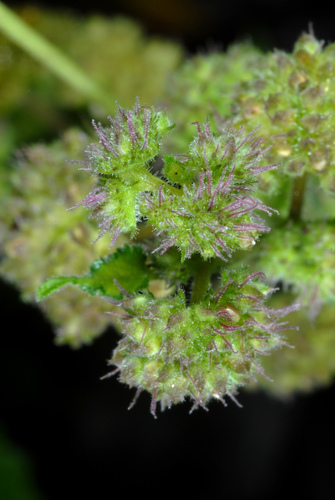
This plant is easily identified by its alternate, heart-shaped (ovate) leaves with serrated margins, which strongly resemble those of a young mulberry tree or a nettle. The entire plant, especially the stem and leaves, is covered in distinct, sticky, glandular hairs (trichomes) that give it a slightly dull, rough texture. It produces dense, globose, greenish-yellow to purple flower clusters (cymes) directly in the leaf axils. The plant typically grows upright, ranging from 10 to 80 centimeters in height depending on moisture and nutrient availability.
Category
PlantsRarity
Common
Danger
1/5 · Very low
Snaps
Be the first to snap!
Despite looking very much like a harmless mulberry seedling, Hairy Crabweed is actually a true herbaceous member of the mulberry family (Moraceae).
It is a notorious pest in commercial greenhouses, earning the nickname 'the nursery hitchhiker' due to its ability to spread secretly in potted soil.
Its tiny seeds are sticky when wet, allowing them to cling to gardening tools, pots, and shoes to travel even longer distances.
The mature flowers can forcefully eject seeds over short distances, allowing the plant to rapidly colonize neighboring nursery pots.
Its stems and leaves are covered in glandular, sticky hairs that deter crawling herbivores and reduce water loss.
It can transition from a newly germinated seed to a mature, seed-producing adult in as little as four weeks.
As an autotrophic plant, Hairy Crabweed produces its own energy via photosynthesis, absorbing water and vital minerals from the soil through its root system.

Diabrotica undecimpunctata
Folivorous beetles frequently feed on the soft leaves of the crabweed.
Myzus persicae
Serves as a host reservoir for common agricultural aphid pests.

Morus rubra
Shares the same family (Moraceae) and competes for soil nutrients and light on woodland edges.
No trait badges are assigned for this object yet.
No aliases listed yet.
Collections for this object will appear here as more themes are added.
Danger
1/5 · Very low
No special safety notes yet.
Start with the whole plant, then compare leaf arrangement, leaf edges, stems and any flowers or fruit. Opposite leaves grow in pairs; alternate leaves come one at a time along the stem. These details tell you far more together than a single green leaf does. Plant Identifier: upload a photo and compare the visible details.
10-80 cm
0.01-0.15 kg
0-1 years
As an autotrophic plant, Hairy Crabweed produces its own energy via photosynthesis, absorbing water and vital minerals from the soil through its root system.
Typically found in disturbed soils, agricultural greenhouses, nursery containers, and shaded garden beds.
5-14 days
Zoom in to split clusters and explore where this object has been snapped.
Recent snaps will appear here as new observations are added.
Take the discovery with you
Snap it with Snappit to identify it, learn what makes it special, and add the discovery to your collection.


















