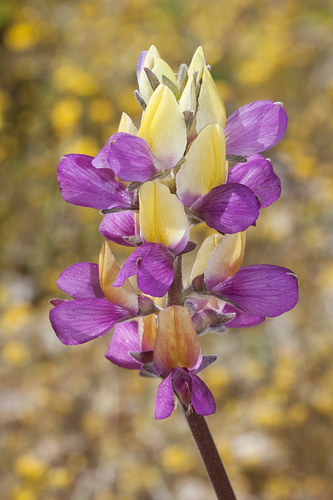


Harlequin Lupine
lupinus stiversii
The Harlequin Lupine, scientifically known as Lupinus stiversii, is a captivating herbaceous plant native to the mountainous regions of California. This species is renowned for its striking, multi-colored flower spikes that add vibrant hues to its natural habitats, making it a favorite among wildflower enthusiasts and a crucial component of its ecosystem. Beyond its aesthetic appeal, the Harlequin Lupine plays a vital ecological role, particularly through its ability to fix atmospheric nitrogen into the soil, enriching its environment and supporting the growth of other plants. It thrives in challenging conditions, showcasing resilience and adaptability in high-altitude and often nutrient-poor soils. Its distinctive appearance and ecological contributions make it a fascinating subject for both scientific study and casual observation in the wild.
Habitat: Found in montane and subalpine habitats, Harlequin Lupine thrives on open slopes, meadows, and clearings, often in dry, rocky, or sandy soils.
Harlequin Lupine stands out with its upright, dense spikes of pea-like flowers, typically displaying a captivating mix of colors ranging from creamy white to pink, purple, and yellow, often with a contrasting banner petal. The individual flowers are arranged in a whorled pattern around the stem, creating a full, showy inflorescence that can reach up to 60 cm in length. Its leaves are palmate, composed of several narrow, silvery-green leaflets radiating from a central point, often covered in fine hairs, giving them a slightly fuzzy texture. The overall plant height usually ranges from 30 to 100 centimeters, forming a sturdy, bushy appearance.
Category
PlantsRarity
Common
Danger
1/5 · Very low
Snaps
1
All parts of the Harlequin Lupine, like many lupine species, contain toxic alkaloids that can be harmful if ingested by livestock or humans.
Harlequin Lupine is known for its nitrogen-fixing capabilities, which enrich the soil and support the health of surrounding plant communities.
Its vibrant, multi-colored flower spikes are a key food source for various native pollinators, especially bumblebees, during the summer months.
This species is endemic to California, showcasing the unique biodiversity of the state's mountainous regions.
Like many legumes, Harlequin Lupine forms a symbiotic relationship with Rhizobium bacteria in its root nodules, allowing it to convert atmospheric nitrogen into a usable form, thereby enriching the soil.
The plant produces a variety of alkaloids, chemical compounds that deter most herbivores from consuming its foliage, seeds, and pods, acting as a natural defense mechanism.
Adapted to the dry conditions of its native montane habitats, Lupinus stiversii possesses mechanisms to withstand periods of low water availability, including deep root systems and hairy leaves that reduce water loss.
As an autotrophic plant, Harlequin Lupine synthesizes its own food through photosynthesis, converting sunlight, carbon dioxide, and water into sugars. It supplements this energy production by absorbing essential mineral nutrients from the soil.
Bombus occidentalis
Pollination of flowers
Rhizobium leguminosarum
Nitrogen fixation in roots

Peromyscus maniculatus
Seed predation

Odocoileus hemionus
Grazing on foliage (limited due to toxicity)
No trait badges are assigned for this object yet.
No aliases listed yet.
Collections for this object will appear here as more themes are added.
Danger
1/5 · Very low
No special safety notes yet.
Start with the whole plant, then compare leaf arrangement, leaf edges, stems and any flowers or fruit. Opposite leaves grow in pairs; alternate leaves come one at a time along the stem. These details tell you far more together than a single green leaf does. Plant Identifier: upload a photo and compare the visible details.
30-100 cm
0.1-0.5 kg
1-3 years
As an autotrophic plant, Harlequin Lupine synthesizes its own food through photosynthesis, converting sunlight, carbon dioxide, and water into sugars. It supplements this energy production by absorbing essential mineral nutrients from the soil.
Found in montane and subalpine habitats, Harlequin Lupine thrives on open slopes, meadows, and clearings, often in dry, rocky, or sandy soils.
Absorption Of Nutrients And Light Capture
50-500
Zoom in to split clusters and explore where this object has been snapped.
Take the discovery with you
Snap it with Snappit to identify it, learn what makes it special, and add the discovery to your collection.