

Harper'S Dodder
cuscuta harperi
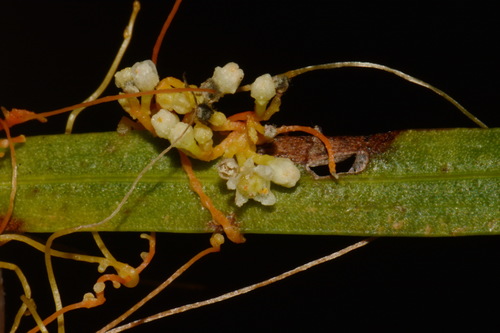
Harper's Dodder (Cuscuta harperi) is an extraordinarily rare, highly specialized parasitic plant endemic to the southeastern United States, primarily found on sandstone glades in Alabama and Georgia. Lacking roots, leaves, and chlorophyll, this intriguing species resembles a tangle of delicate, bright yellow to orange threads draped over its host plants. Instead of drawing nutrients from the soil or sun, it survives entirely by stealth, utilizing specialized structures called haustoria to pierce the stems of host plants and siphon water, carbohydrates, and minerals. Because it is highly host-specific and restricted to fragile rock glade ecosystems, Harper's Dodder is quite rare and serves as a key indicator of pristine sandstone habitat health.
Habitat: Found on sunny, open sandstone outcrops and granite glades, typically parasitizing small herbaceous host plants in thin, acidic soils.
Harper's Dodder presents as a web of thin, hair-like, thread-like stems that are vibrant yellow, orange, or pale green. Because it lacks leaves, the stems are the most prominent feature, tightly twining around host plants. In late summer, it produces clusters of tiny, 2-to-4-millimeter-long white, bell-shaped or tubular flowers with four petals. Its fruits are small, globose capsules containing tiny seeds. The entire plant forms a sprawling, tangled mat that can easily be mistaken for bright orange string wrapped around wildflowers.
Category
PlantsRarity
Common
Danger
1/5 · Very low
Snaps
Be the first to snap!
Dodder seedlings can sniff out host plants by detecting airborne chemical scents, actively crawling towards their preferred host.
Harper's Dodder has no roots or green leaves, meaning it cannot photosynthesize and must steal all of its food.
Once it attaches to a host, the dodder's root dies, leaving it completely airborne and dependent on its victim.
Uses specialized root-like structures called haustoria to penetrate the vascular system of host plants, siphoning water and nutrients without needing chlorophyll.
Seedlings can sense nearby host plants by detecting airborne chemical compounds, guiding their growth toward a host before resources run out.
Upon establishing a successful parasitic connection with a host, the plant's initial terrestrial root dies off completely, leaving it suspended in the air.
Harper's Dodder is an obligate parasite that steals all of its water and nutrients directly from the stems of living host plants.
Age differences: Seedlings rely on seed energy reserves until they locate and parasitize a host plant.
Liatris microcephala
Harper's Dodder parasitizes this plant, wrapping around its stems to draw nutrients.
Helianthus longifolius
Another common glade-dwelling host species that Harper's Dodder feeds upon.
No trait badges are assigned for this object yet.
No aliases listed yet.
Collections for this object will appear here as more themes are added.
Danger
1/5 · Very low
No special safety notes yet.
Start with the whole plant, then compare leaf arrangement, leaf edges, stems and any flowers or fruit. Opposite leaves grow in pairs; alternate leaves come one at a time along the stem. These details tell you far more together than a single green leaf does. Plant Identifier: upload a photo and compare the visible details.
10-100 cm
0.001-0.01 kg
1 years
Harper's Dodder is an obligate parasite that steals all of its water and nutrients directly from the stems of living host plants.
Found on sunny, open sandstone outcrops and granite glades, typically parasitizing small herbaceous host plants in thin, acidic soils.
Parasitism
Zoom in to split clusters and explore where this object has been snapped.
Recent snaps will appear here as new observations are added.
Take the discovery with you
Snap it with Snappit to identify it, learn what makes it special, and add the discovery to your collection.