

Hopkins' Rose Nudibranch
ceratodoris rosacea
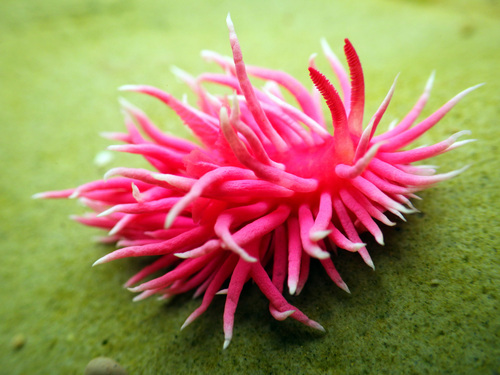
The Hopkins' Rose Nudibranch is a breathtakingly vibrant sea slug native to the rocky tide pools of the North American Pacific coast. Resembling a tiny, glowing pink flower, this sea slug captures the imagination of tide-poolers and marine biologists alike. Its intense rose-pink coloration and elegant form make it one of the most recognizable marine invertebrates in its range, serving as a brilliant example of specialized ecological adaptation. Despite its delicate, soft appearance, it is a hardy survivor in the turbulent and highly competitive intertidal zone.
Habitat: Found in rocky intertidal tide pools and shallow reefs along the Pacific coast, often clinging to the undersides of damp rocks.
This small sea slug grows up to 3 centimeters in length and is covered in long, soft, tapering pink papillae that closely resemble flower petals or thick tentacles. Its entire body, including its sensory rhinophores and gills, is a uniform, brilliant shade of rose-pink, which helps it blend seamlessly with the pink bryozoan colonies it colonizes.
Category
InvertebrateRarity
Common
Danger
1/5 · Very low
Snaps
6
During warm-water ocean events like El Niño, these southern nudibranchs undergo massive population blooms and expand their range far northward into Oregon.
Their bright pink color serves as warning coloration (aposematism) to warn predators of their terrible taste and toxic chemicals.
They lay their eggs in beautiful, rose-pink, gelatinous ribbons that are coiled and glued directly onto rocky substrates near their food source.
It extracts defensive chemical compounds and pink pigments from its prey, incorporating them into its own body for color and toxicity.
It can shed its long, delicate papillae when threatened by a predator, leaving them behind as a distraction while it crawls away.
Uses specialized rhinophores on its head to detect chemical trails left by its preferred food source in the water.
Feeds almost exclusively on rose-colored encrusting bryozoans, acquiring nourishment and its iconic pigmentation.
Integrispora alata
Feeds exclusively on this rosy encrusting bryozoan, acquiring both its nourishment and its striking pink pigment.
Navanax inermis
Preys upon various nudibranchs, including the Hopkins' Rose Nudibranch, in coastal tide pool ecosystems.
No trait badges are assigned for this object yet.
No aliases listed yet.
Collections for this object will appear here as more themes are added.
Danger
1/5 · Very low
No special safety notes yet.
The easiest way to identify Hopkins' Rose Nudibranch is to use the Snappit nature identifier app.
1-3 cm
0.001-0.005 kg
1 years
Feeds almost exclusively on rose-colored encrusting bryozoans, acquiring nourishment and its iconic pigmentation.
Found in rocky intertidal tide pools and shallow reefs along the Pacific coast, often clinging to the undersides of damp rocks.
Grazing精/foraging (grazing) Check: Grazing Is Valid. Let's Use Grazing. Wait, The Prompt Says 'huntingmethod: Pursuit, Ambush, Foraging, Grazing, Filtering, Etc.' So 'grazing' Is Perfect. Let's Use 'grazing'. Check: Primaryfoods Is Array. Let's Write ["rosy Bryozoan","integrispora Alata"]. Let's Keep It Simple. Let's Write: ["rosy Bryozoan","encrusting Bryozoans"]. Let's Set 'grazing' For Huntingmethod. Let's Write 'larvae Are Planktonic And Feed On Microscopic Plankton Before Settling And Undergoing Metamorphosis.' For Dietchangeswithage. Let's Make Sure It's Valid Json. Let's Write: "dietchangeswithage":"larvae Are Planktonic And Feed On Plankton Before Settling And Transitioning To A Bryozoan Diet."
100-2000
Zoom in to split clusters and explore where this object has been snapped.

California, US
You might spot Peridot Sweat Bee and Western Fence Lizard.
View guide →

California, US
You might spot Sunburst Anemone, Ochre Sea Star, and Striped Shore Crab.
View guide →

California, US
You might spot Western Gull, Western Fence Lizard, and Brown Pelican.
View guide →

California, US
You might spot Sunburst Anemone and Striped Shore Crab.
View guide →
Take the discovery with you
Snap it with Snappit to identify it, learn what makes it special, and add the discovery to your collection.