
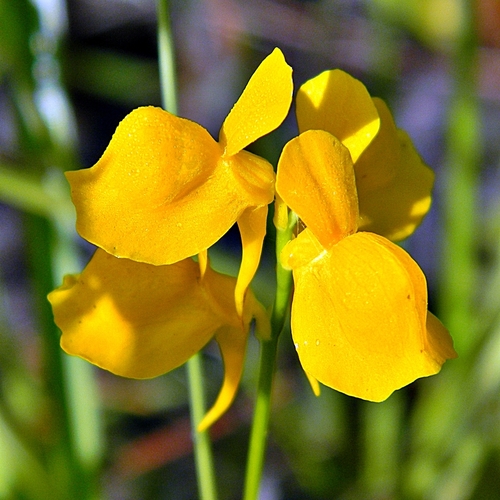


Horned Bladderwort
utricularia cornuta
The Horned Bladderwort is a fascinating carnivorous wildflower native to wet, acidic environments across North America. Despite its delicate appearance, this plant is a formidable predator. Because it grows in nutrient-poor bog soils and shallow waters, it has evolved a highly specialized method of survival. Lacking true roots, it utilizes a network of subterranean or underwater stems equipped with microscopic bladder traps that capture tiny invertebrates with explosive speed. Above the soggy substrate, the plant presents a beautiful contrast to its muddy habitat. It sends up slender, leafless stalks topped with bright yellow flowers, each featuring a distinctive, horn-like spur. This combination of delicate floral beauty and sophisticated subterranean hunting makes the Horned Bladderwort a favorite among botanists and nature enthusiasts alike.
Habitat: Typically found in wet, acidic environments such as sandy or peaty bogs, fens, lakeshores, and wet ditches.
This plant is easily identified by its vibrant, snapdragon-like yellow flowers that bloom on erect, slender, reddish-brown stalks rising 10 to 30 centimeters high. Each flower features a prominent, downward-pointing spur, or 'horn', which measures about 1 to 1.5 centimeters in length. The leaves are largely absent or reduced to microscopic, root-like structures hidden beneath the mud or water, bearing tiny, translucent bladder-like traps that are rarely visible to the naked eye without disturbing the substrate.
Category
PlantsRarity
Common
Danger
1/5 · Very low
Snaps
Be the first to snap!
Each bladder trap operates with a built-in cellular pump that continually bails out water to maintain a constant internal vacuum, primed for the next victim.
The common name 'Horned' refers to the prominent downward-pointing spur at the base of the yellow flower, which resembles a tiny spur or horn.
The suction traps of the Horned Bladderwort are among the fastest moving plant structures in the world, snapping shut in less than a millisecond.
Unlike most terrestrial plants, this species lacks true roots, relying instead on modified underground stems to anchor itself.
Utilizes subterranean or underwater bladders that maintain a negative pressure vacuum, snapping open in less than a millisecond when trigger hairs are touched to suck in prey.
Lacks true roots, anchoring itself instead via modified stolons and rhizoids in loose, saturated soil or shallow water.
Thrives in extremely nutrient-deficient, highly acidic soils by digesting organic matter and small invertebrates to supplement nitrogen and phosphorus.
Captures and digests microscopic soil and aquatic invertebrates using subterranean vacuum-suction traps.
Cyclops bicuspidatus
Captures and digests copepods in its underwater or subterranean bladder traps.

Lasioglossum pectorale
Bees visit the yellow flowers for nectar and transport pollen, facilitating fertilization.
Drosera intermedia
Shares wet, nutrient-poor bog habitats and competes for similar small invertebrate prey.
No trait badges are assigned for this object yet.
No aliases listed yet.
Collections for this object will appear here as more themes are added.
Danger
1/5 · Very low
No special safety notes yet.
Start with the whole plant, then compare leaf arrangement, leaf edges, stems and any flowers or fruit. Opposite leaves grow in pairs; alternate leaves come one at a time along the stem. These details tell you far more together than a single green leaf does. Plant Identifier: upload a photo and compare the visible details.
10-30 cm
0.001-0.01 kg
1-5 years
Captures and digests microscopic soil and aquatic invertebrates using subterranean vacuum-suction traps.
Typically found in wet, acidic environments such as sandy or peaty bogs, fens, lakeshores, and wet ditches.
Ambush
Zoom in to split clusters and explore where this object has been snapped.
Recent snaps will appear here as new observations are added.
Take the discovery with you
Snap it with Snappit to identify it, learn what makes it special, and add the discovery to your collection.


















