

House Mosquito Complex
culex pipiens
The House Mosquito Complex, scientifically known as Culex pipiens, is one of the most widespread and familiar insects encountered in human-altered environments across temperate regions worldwide. Often buzzing unnoticed in the shadows of twilight, these tiny but highly adapted survivors are the classic 'common mosquitoes' found hovering around backyards, gardens, and urban spaces. While frequently regarded simply as a nuisance, the House Mosquito is an evolutionary marvel with highly tuned sensory organs capable of tracking hosts from impressive distances. Interestingly, the term 'complex' refers to a group of closely related subspecies or forms—some adapted to above-ground, bird-biting behaviors, and others known to thrive in subterranean spaces like subway systems where they readily bite mammals, including humans. While their reputation is heavily tied to their role as vectors for diseases such as West Nile Virus and avian malaria, they are also a crucial, abundant food source for an immense variety of wildlife, cementing their place at the foundational levels of urban and wetland ecosystems.
Habitat: Found in a diverse array of environments globally, typically thriving near stagnant, organic-rich water sources like storm drains, birdbaths, old tires, and marshy edges.
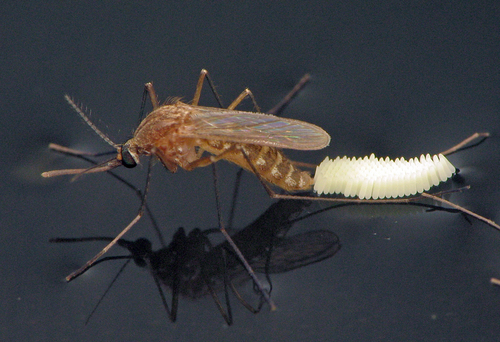
Culex pipiens is a small, relatively plain-looking mosquito, typically measuring less than a centimeter in length. It possesses a slender, light brown to golden-brown body, conspicuously lacking the striking black-and-white stripes seen in many Aedes mosquito species. The defining visual markers include pale, slightly curved bands across the segments of its abdomen and uniformly colored, unbanded brown legs. Its wings are translucent with delicate, dark scales along the veins. Females feature a long, needle-like proboscis built for piercing skin, while the males are easily distinguished by their spectacularly feathery, plumose antennae, which they use to detect the faint acoustic vibrations of female wing-beats in flight.
Category
InsectsRarity
Common
Danger
1/5 · Very low
Snaps
Be the first to snap!
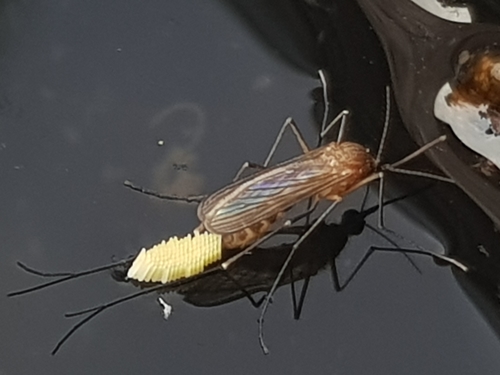
Female Culex mosquitoes can lay hundreds of eggs during their lifetime, neatly arranging them into floating rafts that look like tiny flecks of soot on the water's surface.
Male mosquitoes do not bite at all; they lack the necessary robust mouthparts to pierce skin and live their short lives peacefully drinking flower nectar.
The London Underground mosquito (Culex pipiens molestus) is a distinct form of this species that evolved entirely in subway systems to bite humans instead of birds.
Utilizes highly specialized maxillary palps to detect microscopic plumes of carbon dioxide exhaled by hosts from up to 30 meters away.
Mated females can enter a state of suspended animation, producing natural cryoprotectant compounds to survive freezing winter temperatures.
Females meticulously glue their eggs together into a structured, boat-like raft that utilizes surface tension to float perfectly on the water's surface.
Adult males and females rely on plant nectars for daily energy, but reproducing females require the protein from blood meals to develop their eggs.
Age differences: Aquatic larvae are filter feeders that consume algae, bacteria, and microscopic organic detritus, whereas adults transition to plant nectar and host blood.
Eptesicus fuscus
Bats frequently hunt adult mosquitoes during their nocturnal foraging flights.

Passer domesticus
Female mosquitoes frequently feed on the blood of roosting urban birds, transmitting avian malaria.

Anax junius
Dragonflies are voracious predators of both adult mosquitoes and their aquatic larvae.
No trait badges are assigned for this object yet.
Collections for this object will appear here as more themes are added.
Danger
1/5 · Very low
No special safety notes yet.
Look for six legs, antennae, three body sections and the shape of the wings. Beetles have hardened front wings; flies have just one working pair. Tiny insects may need a close view before their group is clear. Insect Identifier: upload a photo and compare the visible details.
0-1 cm
0-1 cm
0.000001-0.000003 kg
0-1 years
2 km/h
Adult males and females rely on plant nectars for daily energy, but reproducing females require the protein from blood meals to develop their eggs.
Found in a diverse array of environments globally, typically thriving near stagnant, organic-rich water sources like storm drains, birdbaths, old tires, and marshy edges.
Zoom in to split clusters and explore where this object has been snapped.
Recent snaps will appear here as new observations are added.
Take the discovery with you
Snap it with Snappit to identify it, learn what makes it special, and add the discovery to your collection.