



Ichneumonid And Braconid Wasps
ichneumonoidea
The Ichneumonoidea superfamily includes the incredibly diverse Ichneumonid and Braconid wasps, representing one of the most species-rich and ecologically vital groups of insects on Earth. Far from the aggressive, stinging hornets many people imagine, these slender and fascinating wasps are primarily parasitoids. They lay their eggs inside or on other insects, spiders, and arthropods, playing an unparalleled role in naturally controlling pest populations. Without them, herbivorous insects could easily overwhelm terrestrial ecosystems. Because of their staggering diversity, Ichneumonoids have evolved a vast array of specialized shapes and behaviors to seek out hosts concealed in wood, curled in leaves, or buried in soil. From microscopic Braconids that parasitize tiny aphids to gigantic Ichneumons with exceptionally long ovipositors that drill into tree trunks, these wasps are the silent, unsung heroes of the natural world and vital allies in agricultural pest control.
Habitat: Found in forests, open meadows, urban gardens, and agricultural fields worldwide, typically occurring wherever there is a stable population of host insects.
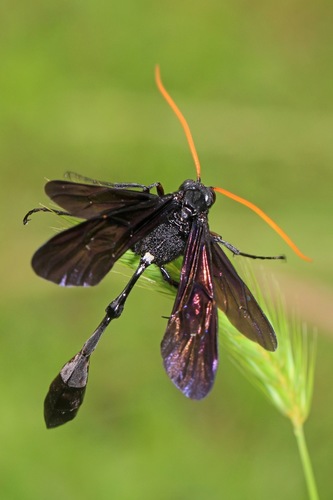
Ichneumonid and Braconid wasps are remarkably diverse in appearance, but most share a slender, elongated body plan and noticeably long antennae that typically feature 16 or more segments. Their coloration ranges from stealthy, uniform blacks and browns to vibrant warning patterns of bright orange, red, and yellow. A key visual identifier for many females is the presence of a prominent, needle-like ovipositor extending from the rear of the abdomen; in some species, this egg-laying organ is several times the length of the wasp's body. They possess distinctively veined, transparent wings that lay flat along their backs when at rest, and their bodies often feature a characteristic "wasp waist" (petiole) that connects the thorax to a gracefully curved abdomen.
Category
InsectsRarity
Common
Danger
1/5 · Very low
Snaps
Be the first to snap!
Charles Darwin was famously disturbed by the Ichneumon wasp's gruesome lifecycle, writing that he could not persuade himself that a beneficent God would create a creature specifically to eat caterpillars from the inside out.
Despite their intimidating, needle-like ovipositors, the vast majority of Ichneumonid and Braconid wasps cannot sting humans, as the organ is modified purely for laying eggs.
Some species possess metallic zinc or manganese hardened into the tips of their ovipositors, allowing the wasp to literally drill through solid wood without wearing down its egg-laying tool.
When a Braconid wasp parasitizes a caterpillar, the virus it injects to suppress the host's immune system is actually produced in the wasp's own ovaries.
Females can detect the subtle vibrations or specific chemical odors of concealed host larvae, locating them accurately even when they are buried deep inside solid wood.
Certain species possess incredibly long, metallic-reinforced ovipositors capable of boring through solid tree bark and wood to deposit eggs onto hidden hosts.
Many of these wasps inject symbiotic polydnaviruses alongside their eggs to safely disarm and suppress the host insect's immune system, ensuring the survival of the wasp larvae.
The larvae are obligate parasitoids that consume their insect hosts from the inside out, while adult wasps primarily feed on plant nectars to sustain their energy.
Age differences: Larvae are strictly carnivorous parasitoids of other insects, whereas mature adults generally shift to a non-predatory diet of floral nectar or honeydew.
Manduca quinquemaculata
Braconid wasps commonly parasitize and ultimately kill the highly destructive Tomato Hornworm.
Daucus carota
Adult wasps frequently rely on the shallow, accessible nectar from plants like the Wild Carrot for energy.
Tremex columba
Giant Ichneumon wasps specifically seek out wood-boring Horntail larvae to parasitize beneath tree bark.

Sayornis phoebe
Many insectivorous bird species opportunistically hunt and consume adult ichneumonid wasps.
Solitary animals live alone for most of their lives, only interacting with others for mating or parental care.
Colorful describes organisms or objects displaying a wide range of bright and distinct colors.
Describes plants that are particularly attractive and beneficial to a wide range of pollinating organisms.
Describes a relationship between two different species where they live in close association, often benefiting one or both.
Forest habitats are terrestrial environments dominated by dense tree cover, supporting a high diversity of plant and animal life.
Diurnal animals are primarily active during daylight hours, typically resting or sleeping at night.
Describes a species whose presence and role have a disproportionately large effect on its environment.
Pertaining to species that are significantly smaller than typical or average for their kind.
This trait describes organisms that live on or in a host organism, obtaining nutrients at the host's expense.
Describes organisms that transfer pollen, enabling the fertilization and reproduction of plants.
No aliases listed yet.
Collections for this object will appear here as more themes are added.
Danger
1/5 · Very low
No special safety notes yet.
Compare the antennae, wings, waist, body hair and legs. Yellow and black stripes show up on bees, wasps and harmless mimics alike. Bee & Wasp Identifier: upload a photo and compare the visible details.
0-13 cm
0-8 cm
0-0.002 kg
0 years
The larvae are obligate parasitoids that consume their insect hosts from the inside out, while adult wasps primarily feed on plant nectars to sustain their energy.
Found in forests, open meadows, urban gardens, and agricultural fields worldwide, typically occurring wherever there is a stable population of host insects.
Foraging
Zoom in to split clusters and explore where this object has been snapped.
Recent snaps will appear here as new observations are added.

Washington, US
You might spot Common Jewelweed, Pacific Banana Slug, and Thimbleberry.
View guide →

British Columbia, CA
You might spot Vine Maple, Orange Honeysuckle, and Licorice Fern.
View guide →
Take the discovery with you
Snap it with Snappit to identify it, learn what makes it special, and add the discovery to your collection.