
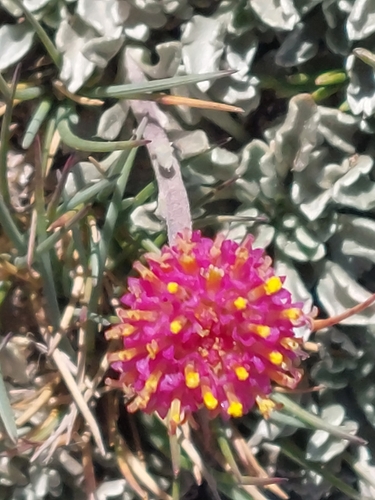


Jacobaea Boissieri
jacobaea boissieri
Jacobaea boissieri is a rare, high-altitude perennial herb endemic to the rugged, snow-swept peaks of southern Spain's Sierra Nevada range. This resilient member of the Asteraceae family has evolved to thrive in some of the most unforgiving alpine environments on the Iberian Peninsula, specifically colonizing dolomitic gravels, scree slopes, and windy mountain crevices. Despite the harsh wind, low temperatures, and intense solar radiation of its home, it puts on a spectacular display of golden-yellow blossoms during the short alpine summer. Its striking silvery foliage represents an incredible adaptation to prevent water loss and reflect excessive ultraviolet light, ensuring its survival where few other plants can cling to life.
Habitat: Found in high-altitude alpine zones, specifically on dolomitic sands, loose limestone screes, and rocky crevices of southern Spain's mountain ranges.
This low-growing perennial features a compact, cushion-like growth habit, typically reaching heights of only 5 to 15 centimeters. Its leaves are deeply lobed and covered in a dense, woolly coat of white hairs, giving the entire plant a distinct silvery-gray or frosted appearance. From mid-to-late summer, it produces small, bright yellow daisy-like flower heads clustered at the ends of short, erect stems, creating a brilliant contrast against dark, rocky mountain screes.
Category
PlantsRarity
Common
Danger
1/5 · Very low
Snaps
Be the first to snap!
Despite living in southern Spain, a region famous for hot weather, this plant survives sub-freezing winter temperatures under heavy snow blankets for months.
Its dense, woolly leaf coating works like a miniature greenhouse, trapping a boundary layer of warm, moist air close to the leaf surface to aid survival in freezing winds.
The species name 'boissieri' honors the famous Swiss botanist Pierre Edmond Boissier, who thoroughly explored and documented the unique flora of Spain during the 19th century.
The dense layer of white, woolly hairs covering its leaves reflects intense alpine UV rays and reduces moisture loss from high-altitude winds.
Specialized metabolic pathways allow this plant to thrive in magnesium-rich, nutrient-poor soils that are toxic to most other vegetation.
A tenacious, deep-reaching taproot system secures the plant in loose, shifting gravel slopes and prevents it from being washed away during heavy snowmelts.
As a photoautotrophic plant, it produces its own energy through photosynthesis, utilizing sunlight, carbon dioxide, and minerals absorbed from high-altitude soils.
Bombus terrestris
Pollinated by alpine insects seeking nectar during the brief summer flowering window.
Viola nevadensis
Competes with other specialized alpine endemics for limited moisture and space in dolomitic crevices.
Messor barbarus
Seeds are occasionally gathered and consumed by specialized high-altitude foraging ants.
No trait badges are assigned for this object yet.
No aliases listed yet.
Collections for this object will appear here as more themes are added.
Danger
1/5 · Very low
No special safety notes yet.
Start with the whole plant, then compare leaf arrangement, leaf edges, stems and any flowers or fruit. Opposite leaves grow in pairs; alternate leaves come one at a time along the stem. These details tell you far more together than a single green leaf does. Plant Identifier: upload a photo and compare the visible details.
5-15 cm
0.01-0.05 kg
5-15 years
As a photoautotrophic plant, it produces its own energy through photosynthesis, utilizing sunlight, carbon dioxide, and minerals absorbed from high-altitude soils.
Found in high-altitude alpine zones, specifically on dolomitic sands, loose limestone screes, and rocky crevices of southern Spain's mountain ranges.
Zoom in to split clusters and explore where this object has been snapped.
Recent snaps will appear here as new observations are added.
Take the discovery with you
Snap it with Snappit to identify it, learn what makes it special, and add the discovery to your collection.


















