

Knotted Wrack
ascophyllum nodosum
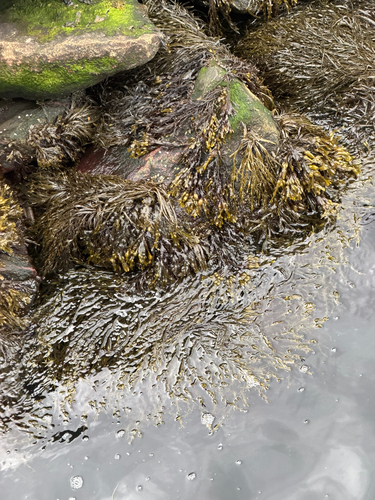
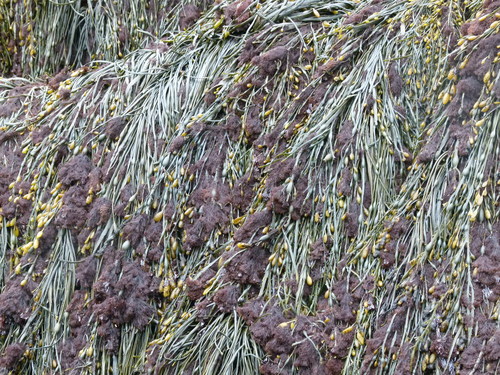
Knotted Wrack (Ascophyllum nodosum), also known as egg wrack, is a dominant and incredibly resilient brown seaweed that drapes the rocky shores of the North Atlantic. Growing in slow, majestic sweeps, it forms dense underwater forests during high tide and blankets the intertidal rocks like a heavy, golden-brown carpet when the tide recedes. This long-lived species is not just a plant-like organism; it is a foundational ecosystem engineer, providing critical shelter, moisture, and protection for hundreds of marine invertebrates, small fish, and other algae. Its remarkable ability to withstand extreme shifts in temperature, salinity, and wave action makes it a true survival specialist of the coast. For centuries, coastal communities have harvested Knotted Wrack for use as organic fertilizer, livestock feed, and more recently, in biotechnology and cosmetics.
Habitat: Found on sheltered rocky shores in the middle intertidal zone, where it attaches firmly to rocks and boulders.
Knotted Wrack is easily recognized by its long, strap-like, olive-green to brownish-yellow fronds that lack a central midrib. Along these tough, rubbery branches, it features prominent, egg-shaped air bladders spaced at regular intervals. These bladders grow sequentially once a year, allowing observers to estimate the age of the individual. In the spring, small, bright yellow, club-shaped reproductive structures dangle from the sides of the fronds, adding a vibrant splash of color.
Category
AnimalRarity
Common
Danger
1/5 · Very low
Snaps
3
Because it adds exactly one air bladder to each stem every spring, you can tell the age of a Knotted Wrack branch simply by counting the bladders along its main strand.
During low tide, the dense mats of Knotted Wrack act as a natural sponge, trapping seawater to keep hundreds of species of marine life cool and moist.
Individual holdfasts of Knotted Wrack can survive for several decades, making them some of the longest-lived organisms in the rocky intertidal zone.
It produces exactly one air bladder along each stem every spring, allowing scientists to determine the age of a branch by counting them.
Secretes a thick layer of slimy mucilage that retains moisture, preventing the seaweed from drying out and dying when exposed to air during low tide.
Utilizes a tough, disc-like holdfast that glues itself biochemically to rocky surfaces, resisting the crushing force of heavy waves.
As a photosynthetic organism, it produces its own energy using sunlight, carbon dioxide, and dissolved nutrients from the surrounding seawater.
Polysiphonia lanosa
Grows as an obligate epiphyte on the fronds of Knotted Wrack without harming the host.
Littorina obtusata
Directly feeds on the tissues of Knotted Wrack, preferring its tender young shoots.

Carcinus maenas
Uses the dense wet canopy of the wrack for shelter and moisture during low tide.
No trait badges are assigned for this object yet.
No aliases listed yet.
Collections for this object will appear here as more themes are added.
Danger
1/5 · Very low
No special safety notes yet.
The easiest way to identify Knotted Wrack is to use the Snappit nature identifier app.
50-200 cm
0.2-5 kg
10-15 years
As a photosynthetic organism, it produces its own energy using sunlight, carbon dioxide, and dissolved nutrients from the surrounding seawater.
Found on sheltered rocky shores in the middle intertidal zone, where it attaches firmly to rocks and boulders.
Zoom in to split clusters and explore where this object has been snapped.
May 31, 2026
Connecticut College ArboretumPhoto attribution
(c) Sawyer Baran, some rights reserved (CC BY)
License: CC BY 4.0 ↗
Image may be shown cropped inside the card frame.

Connecticut, US
You might spot Common Mugwort and Canada Goose.
View guide →

US
You might spot Common Eider, American Herring Gull, and Common Periwinkle.
View guide →

Connecticut, US
You might spot Brant, American Herring Gull, and Double-Crested Cormorant.
View guide →

Connecticut, US
You might spot Common Mugwort, Canada Goose, and American Herring Gull.
View guide →

US
You might spot Rugosa Rose and European Green Crab.
View guide →

Maine, US
You might spot American Herring Gull and Himalayan Balsam.
View guide →
Take the discovery with you
Snap it with Snappit to identify it, learn what makes it special, and add the discovery to your collection.