

Kudzu Bug
megacopta cribraria
The Kudzu Bug (Megacopta cribraria), also known as the bean plataspid, is a small but highly impactful invasive insect native to East Asia. First detected in the United States in Georgia in 2009, this tiny bug has quickly spread across the Southeast, causing significant concern for agriculturalists. Despite its pest status, the Kudzu Bug is an intriguing creature. It belongs to the family Plataspidae, which are characterized by their rounded, beetle-like bodies and a unique symbiotic relationship with gut bacteria that they transmit to their offspring in specialized packets called symbiont capsules.
Habitat: Commonly found in open fields, agricultural lands, and roadsides where kudzu vines or legume crops are abundant.
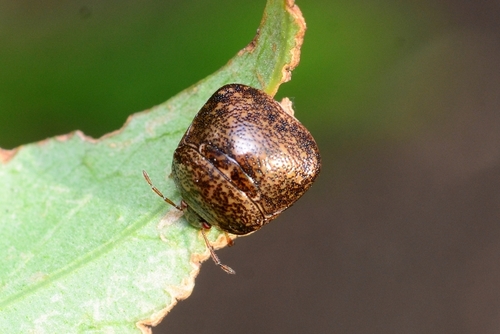
The Kudzu Bug is tiny, measuring between 4 to 6 millimeters in length, and is characterized by a distinctive, square-like or globular body shape that is wider at the rear. It possesses a mottled olive-green, brown, or grayish coloration with numerous dark punctures covering its dorsal surface. Unlike typical true bugs, its scutellum is greatly enlarged, covering almost its entire abdomen and wings. When viewed from above, its body resembles a tiny, armored olive or a small, round beetle, and it has a noticeably flattened, blunt head.
Category
InsectsRarity
Common
Danger
1/5 · Very low
Snaps
3
If a female's eggs are separated from her symbiont capsules, the emerging nymphs will suffer from stunted growth or fail to reach maturity.
Kudzu bugs are not true beetles, despite their round shape; they are true bugs (Hemiptera) and possess piercing-sucking mouthparts.
The chemical defensive spray of the kudzu bug can cause skin irritation, staining, and mild blistering in sensitive individuals.
They are hitchhiking experts; their rapid spread across the United States was heavily aided by clinging to vehicles and shipping containers.
Females deposit nutrient-rich bacterial capsules near their eggs, ensuring the nymphs ingest essential gut symbionts immediately upon hatching.
When threatened or crushed, the bug releases a highly pungent, foul-smelling liquid from abdominal glands to deter potential predators.
During autumn, they can detect radiant heat and gather in massive, huddled groups on warm, light-colored structures to survive the cold.
Feeds exclusively on plant juices, using its piercing-sucking mouthparts to drain nutrients from stems and petioles of legumes.
Age differences: Nymphs and adults feed on the same host plants, but nymphs rely on the specific gut symbionts acquired at hatching to digest the plant juices.

Pueraria montana
Primary host plant and main food source in wild, unmanaged areas.

Glycine max
Agricultural host plant where feeding causes severe yield losses.
Paratelenomus saccharalis
An exotic parasitoid wasp that attacks Kudzu Bug eggs, acting as a potential biological control agent.
No trait badges are assigned for this object yet.
No aliases listed yet.
Collections for this object will appear here as more themes are added.
Danger
1/5 · Very low
No special safety notes yet.
The easiest way to identify Kudzu Bug is to use the Snappit nature identifier app.
0+ cm
0+ cm
0+ kg
0+ years
5 km/h
Feeds exclusively on plant juices, using its piercing-sucking mouthparts to drain nutrients from stems and petioles of legumes.
Commonly found in open fields, agricultural lands, and roadsides where kudzu vines or legume crops are abundant.
Zoom in to split clusters and explore where this object has been snapped.

South Carolina, US
You might spot Anole, Green Treefrog, and Eastern Gray Squirrel.
View guide →

South Carolina, US
You might spot Anole, Asian Lady Beetle, and Gulf Fritillary.
View guide →

Tennessee, US
You might spot American Robin, Northern Cardinal, and Eastern Chipmunk.
View guide →

Tennessee, US
You might spot American Robin and Eastern Gray Squirrel.
View guide →

Alabama, US
You might spot Northern Mockingbird, Snapping Turtle, and Rabidosa.
View guide →
California, US
You might spot Anole, Chinese Privet, and Muscovy Duck.
View guide →
Take the discovery with you
Snap it with Snappit to identify it, learn what makes it special, and add the discovery to your collection.













.jpg&width=800)




