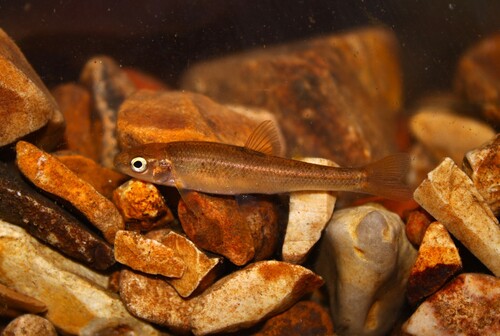


Largescale Stoneroller
campostoma oligolepis
The Largescale Stoneroller is a fascinating, heavy-bodied freshwater minnow native to the clear, gravelly streams of North America. Renowned for its unique ecological role, this industrious fish is a primary grazer, using its specialized cartilaginous lower jaw to scrape algae and organic matter off submerged rocks. During the breeding season, males undergo a dramatic transformation, developing prominent, horn-like tubercles across their heads and bodies and constructing nests by rolling pebbles with their snouts. This behavior not only shapes the stream bed but also creates vital habitats for other aquatic species. Watching a school of these active fish flash their brassy sides in a sunlit riffle is a delight for any stream observer.
Habitat: Found in clear, small to medium-sized streams and creeks with gravel, cobble, or bedrock substrates and moderate to swift currents.
The Largescale Stoneroller features a stout, cylindrical body typically measuring between 8 and 22 centimeters in length. It is characterized by its brownish to olive-green back and brassy, silvery sides, which often shimmer with scattered dark scales. Its most defining feature is its hard, chisel-like lower jaw adapted for scraping. Breeding males display a spectacular array of sharp, whitish tubercles on their head and back, alongside striking orange and black bands running through their dorsal and anal fins, making them highly conspicuous in shallow waters.
Category
FishRarity
Common
Danger
1/5 · Very low
Snaps
3
The sharp, horn-like bumps on breeding males are made of keratin—the same material as human fingernails—and are used to defend territory and stimulate females.
Their intestines are extraordinarily long, wrapping around their swim bladder like thread on a spool to help digest tough algal cell walls.
They earn the name 'stoneroller' because males literally push, shovel, and roll pebbles with their heads to construct large spawning mounds.
Possesses a hard, chisel-like cartilaginous ridge on the lower jaw that acts as a scraper to easily harvest tightly clinging algae from rocks.
Features an exceptionally long intestine wrapped directly around the swim bladder to maximize nutrient extraction from highly fibrous plant matter.
Equipped with a reinforced, blunt snout used to physically push and roll heavy gravel and stones to excavate spawning nests.
Primarily feeds by scraping algae, diatoms, and organic detritus from the surfaces of rocks and gravel in fast-flowing streams.
Age differences: Juveniles consume more small aquatic insects and micro-crustaceans before transition to a strictly herbivorous diet as their specialized scraping jaw matures.

Micropterus salmoides
Preys heavily on stonerollers, controlling their populations in stream pools.
Campostoma anomalum
Competes for identical food resources and rocky nesting territory where ranges overlap.
Ambloplites rupestris
Commonly feeds on the juvenile stonerollers seeking refuge in deeper rocky pools.
No trait badges are assigned for this object yet.
No aliases listed yet.
Collections for this object will appear here as more themes are added.
Danger
1/5 · Very low
No special safety notes yet.
Look at body shape, where the fins sit and their outline, mouth position, stripes and spots. Young fish and breeding adults can wear different patterns, and aquarium color varieties can look nothing like wild fish. Fish Identifier: upload a photo and compare the visible details.
8-22 cm
0.01-0.15 kg
2-4 years
Primarily feeds by scraping algae, diatoms, and organic detritus from the surfaces of rocks and gravel in fast-flowing streams.
Found in clear, small to medium-sized streams and creeks with gravel, cobble, or bedrock substrates and moderate to swift currents.
Grazing
200-4000
Zoom in to split clusters and explore where this object has been snapped.
Take the discovery with you
Snap it with Snappit to identify it, learn what makes it special, and add the discovery to your collection.