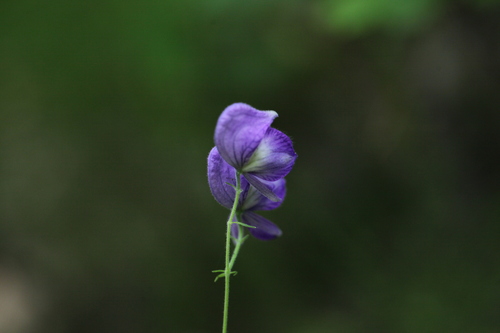


Larkspurleaf Monkshood
aconitum delphiniifolium
Larkspurleaf Monkshood is an enchanting yet formidable perennial wildflower native to the cold, dramatic landscapes of northwestern North America and northeastern Asia. Thriving in alpine meadows and moist subalpine zones, this resilient plant stands out with its striking spikes of deep blue to violet helmet-shaped flowers. It is named for its intricately divided, hand-shaped leaves that bear a striking resemblance to those of the larkspur family. While beautiful to behold, Larkspurleaf Monkshood holds a reputation as one of the most toxic plants in its range. Loaded with potent aconite alkaloids, it acts as a natural deterrent against most herbivores and has historically been utilized in traditional poisons. In the wild, it serves as a vital resource for heavy-bodied pollinators like bumblebees, who are uniquely adapted to navigate its complex, hooded flowers.
Habitat: Found in moist alpine and subalpine meadows, tundra slopes, and along cold forest edges in subarctic regions.
This herbaceous perennial typically grows between 10 and 100 cm tall, featuring erect stems that support loose clusters of deep blue-purple or occasionally yellowish flowers. The most distinguishing feature of each flower is its upper sepal, which is enlarged and curved forward to form a distinct, helmet-like hood measuring 1.5 to 2.5 cm in height. Below the blossoms, the dark green leaves are deeply divided into multiple narrow, pointed lobes, mimicking the foliage of larkspur.
Category
PlantsRarity
Common
Danger
1/5 · Very low
Snaps
Be the first to snap!
All parts of the Larkspurleaf Monkshood are extremely toxic; historically, extracts from related Aconitum species were used to poison harpoons and arrow tips for hunting.
Its scientific species name, 'delphiniifolium', translates to 'larkspur-leaved', referencing the deeply divided, hand-shaped foliage that closely resembles that of the Larkspur genus.
The characteristic 'hood' of the flower is not actually made of petals, but is a highly modified, protective sepal that shelters the true nectar-producing petals inside.
Produces highly toxic aconitine alkaloids throughout all tissues, acting as an incredibly effective chemical deterrent against grazing mammalian herbivores.
Features highly specialized hooded flowers that require the strength and weight of large bumblebees to pry open, ensuring precise, targeted pollination.
Maintains a resilient underground tuberous root system that safely stores energy to survive freezing subarctic winters and fuel rapid growth in spring.
Synthesizes its own energy using sunlight, carbon dioxide, and water while absorbing essential minerals from the soil.
Bombus polaris
Primary pollinator strong enough to access the nectar inside the complex hooded flower.
Polychrysia esmeralda
The specialized caterpillars of this moth feed on the toxic foliage of Ranunculaceae plants, including monkshood.
No trait badges are assigned for this object yet.
No aliases listed yet.
Collections for this object will appear here as more themes are added.
Danger
1/5 · Very low
No special safety notes yet.
Start with the whole plant, then compare leaf arrangement, leaf edges, stems and any flowers or fruit. Opposite leaves grow in pairs; alternate leaves come one at a time along the stem. These details tell you far more together than a single green leaf does. Plant Identifier: upload a photo and compare the visible details.
10-100 cm
3-10 years
Synthesizes its own energy using sunlight, carbon dioxide, and water while absorbing essential minerals from the soil.
Found in moist alpine and subalpine meadows, tundra slopes, and along cold forest edges in subarctic regions.
Photosynthesis
Zoom in to split clusters and explore where this object has been snapped.
Recent snaps will appear here as new observations are added.
Take the discovery with you
Snap it with Snappit to identify it, learn what makes it special, and add the discovery to your collection.