

Laurobasidium Lauri
laurobasidium lauri
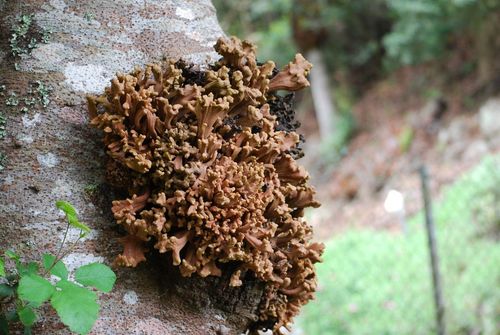
Laurobasidium lauri is a fascinating, host-specific parasitic fungus famous for producing dramatic, antler-like growths on the trunks and branches of laurel trees. Found exclusively in the unique, mist-shrouded Laurisilva forests of Macaronesia (including Madeira, the Azores, and the Canary Islands), this species induces the host plant to form large, woody galls known locally as 'Madre de louro' (Laurel Mother). Despite its parasitic nature, it typically coexists with its host for many years without killing it. This fungus plays a distinctive role in the cloud forest ecosystem, showcasing a highly evolved and specialized symbiotic relationship that relies entirely on the humid, ancient laurel forest environment.
Habitat: Found in humid, high-altitude laurel forests (Laurisilva), growing exclusively as a parasite on the trunks and branches of Macaronesian laurel trees.
In the wild, Laurobasidium lauri is easily recognized by its spectacular, multi-lobed, or antler-like galls erupting directly from the bark of laurel trees. These growths are typically yellowish-brown to dark chocolate brown, with a tough, woody-fleshy texture. They can range in size from small, finger-like projections of a few centimeters to massive, branched structures reaching up to 50 centimeters in length. During periods of high humidity, the surface of these galls may take on a velvety, pale appearance as they become covered in microscopic, spore-producing structures.
Category
FungiRarity
Common
Danger
1/5 · Very low
Snaps
Be the first to snap!
Despite forming massive, tumor-like growths, the fungus rarely kills its host tree, maintaining a stable parasitic equilibrium for decades.
In Madeira, these bizarre growths are traditionally called 'Madre de louro', which translates to 'Laurel Mother'.
Its appearance is highly weather-dependent; the dry galls look like dead wood, but they swell and become active spore-producers in heavy mist.
Chemical signaling triggers the host laurel tree to grow massive, protective woody structures that house and feed the fungus.
Releases spores predominantly during periods of high mist and rainfall, ensuring optimal conditions for colonization.
The vegetative structure survives for multiple years within the host tissues, producing new spore-bearing galls season after season.
Absorbs water, carbohydrates, and vital nutrients directly from the living vascular tissues of its host laurel trees.
Laurus novocanariensis
Acts as a host-specific parasite, inducing gall formation on the branches and trunk of this endemic tree.
Laurus azorica
Utilizes this host tree species in the Azores to obtain nutrition and structural support.
No trait badges are assigned for this object yet.
No aliases listed yet.
Collections for this object will appear here as more themes are added.
Danger
1/5 · Very low
No special safety notes yet.
Compare the cap shape, the underside, the stem and base, and whether the fungus grows on wood or soil. Some fungi have gills, others pores or teeth. A cap seen only from above often hides the most useful features. Mushroom Identifier: upload a photo and compare the visible details.
5-50 cm
0.1-2 kg
2-15 years
Absorbs water, carbohydrates, and vital nutrients directly from the living vascular tissues of its host laurel trees.
Found in humid, high-altitude laurel forests (Laurisilva), growing exclusively as a parasite on the trunks and branches of Macaronesian laurel trees.
Parasitic Absorption
Zoom in to split clusters and explore where this object has been snapped.
Recent snaps will appear here as new observations are added.
Take the discovery with you
Snap it with Snappit to identify it, learn what makes it special, and add the discovery to your collection.