
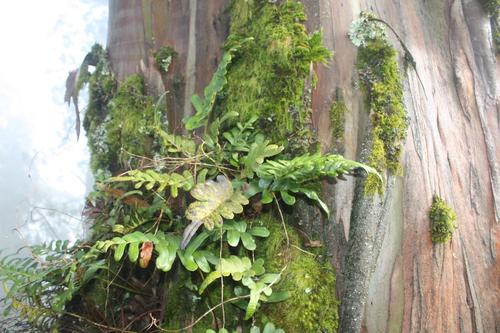


Leathery Polypody
polypodium scouleri
The Leathery Polypody (Polypodium scouleri) is a robust, evergreen fern that clings beautifully to the rocky coasts and temperate rainforests of western North America. Renowned for its extreme resilience, this plant thrives in the harsh, salty winds of the Pacific shoreline, often draping coastal cliffs and the mossy trunks of giant conifers in lush, vibrant green. Its ability to absorb moisture directly from coastal fog makes it an essential component of its misty, damp ecosystem.
Habitat: Found on wet coastal cliffs, rocky headlands, and epiphytically on mossy tree trunks within the immediate salt-spray zone of the Pacific Northwest.
This distinctive fern features glossy, deep green fronds that are remarkably thick, rubbery, and leathery to the touch. The fronds are pinnately divided with broad, rounded segments and wavy margins, typically growing between 15 and 50 centimeters in length. On the undersides of mature leaves, prominent, circular, bright orange-to-yellow spore clusters (sori) are arranged in neat rows, creating a striking contrast against the dark green foliage.
Category
PlantsRarity
Common
Danger
1/5 · Very low
Snaps
Be the first to snap!
Indigenous peoples of the Pacific Northwest historically used the sweet, licorice-flavored rhizomes of related polypodies as medicine and survival food.
Its species name 'scouleri' honors John Scouler, a Scottish naturalist who famously explored the Pacific Northwest in the early 19th century.
Unlike many delicate woodland ferns that shrivel under wind, its fronds are so thick and rubbery they feel almost like leather or plastic.
Its thick, waxy cuticle protects the foliage from being damaged or dehydrated by constant exposure to salty marine winds.
The shape and texture of the fronds are optimized to capture moisture from coastal fog, channeling water droplets directly to its roots.
Fleshy, scaly rhizomes allow the fern to secure a powerful grip on vertical rock faces and moss-covered tree bark without needing soil.
As a photoautotrophic fern, it synthesizes its own sugars using sunlight, water, and carbon dioxide, while absorbing dissolved minerals from rain, fog, and decaying organic matter.

Picea sitchensis
Grows epiphytically on the moss-covered trunk and branches of this coastal conifer.
Monadenia fidelis
Provides shelter and moisture, but young fronds may occasionally be grazed by this snail.

Isothecium myosuroides
Shares cliffside and bark real estate, helping to retain the moisture the fern needs to thrive.
No trait badges are assigned for this object yet.
No aliases listed yet.
Collections for this object will appear here as more themes are added.
Danger
1/5 · Very low
No special safety notes yet.
Compare frond shape, how the leaflets are arranged, the stalk, and any spore clusters you can see. A single detached leaflet often hides the plant's overall growth pattern. Fern Identifier: upload a photo and compare the visible details.
15-50 cm
10-25 years
As a photoautotrophic fern, it synthesizes its own sugars using sunlight, water, and carbon dioxide, while absorbing dissolved minerals from rain, fog, and decaying organic matter.
Found on wet coastal cliffs, rocky headlands, and epiphytically on mossy tree trunks within the immediate salt-spray zone of the Pacific Northwest.
Zoom in to split clusters and explore where this object has been snapped.
Recent snaps will appear here as new observations are added.
Take the discovery with you
Snap it with Snappit to identify it, learn what makes it special, and add the discovery to your collection.

















