
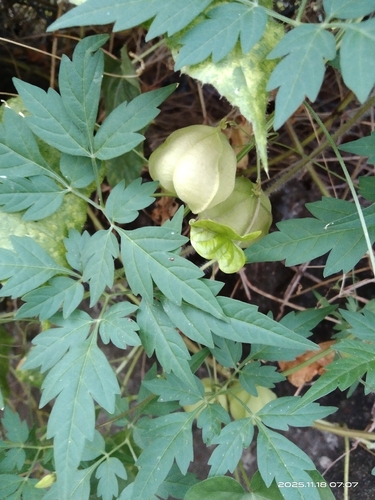


Lesser Balloon Vine
cardiospermum halicacabum
The Lesser Balloon Vine (Cardiospermum halicacabum) is a charming, fast-growing climbing plant famous for its whimsical, inflated green seed pods that resemble miniature hot air balloons. Native to tropical and subtropical regions of Africa, Asia, and the Americas, this delicate deciduous vine uses wiry tendrils to scramble over fences, shrubs, and trees. Its genus name, Cardiospermum, translates to 'heart seed', referencing the striking heart-shaped white mark found on its dark, round seeds—a feature that has also earned it the romantic common name 'Love in a Puff'. While loved for its ornamental appeal and historical uses in traditional herbal medicine, particularly for its anti-inflammatory properties, this vigorous vine can sometimes become a bit too enthusiastic in its growth, acting as an invasive weed in certain non-native habitats. Observing its delicate white blossoms transition into puffy green globes is a true delight for any nature spotter.
Habitat: Found in disturbed areas, forest edges, riverbanks, and roadsides in tropical and warm temperate zones, often climbing over other vegetation.
This herbaceous vine is easily recognized by its alternate, deeply divided leaflets with serrated margins, which grow along thin, green stems equipped with bifurcate tendrils. Its flowers are tiny, measuring only 3 to 4 millimeters across, featuring four delicate white petals and bright yellow centers. However, the plant's most striking visual identifier is its fruit: a three-angled, papery, inflated capsule that starts as a vibrant lime green and matures into a dry, paper-like straw brown. Inside each puff are three spherical, black-to-dark-brown seeds, each distinctly marked with a white, heart-shaped hilum.
Category
PlantsRarity
Common
Danger
1/5 · Very low
Snaps
Be the first to snap!
In traditional medicine, extracts from this plant are used to treat skin conditions like eczema and psoriasis due to their anti-inflammatory properties.
Its inflated capsules work as buoyant flotation devices, allowing the seeds to disperse naturally along rivers and streams.
The common name 'Love in a Puff' refers to the romantic heart-shaped seed hidden safely inside the balloon-like outer casing.
The genus name Cardiospermum is Greek for 'heart seed', inspired by the distinct heart-shaped white mark on each of its black seeds.
The papery, air-filled capsules function as flotation devices, allowing seeds to disperse via waterways, and also protect developing seeds from insect predators.
Specialized, fork-like tendrils emerge from flower stalks to wrap tightly around surrounding structures, helping the vine ascend quickly towards sunlight.
The plant produces saponins, tannins, and flavonoids that act as natural deterrents against various herbivores and pests.
As an autotrophic plant, it synthesizes its own food using sunlight, carbon dioxide, water, and minerals through photosynthesis.
Parasa lepida
The larvae of this moth species feed on the leaves of the balloon vine.

Jadera haematoloma
The red-shouldered bug specifically feeds on the seeds inside the inflated pods.
Apis mellifera
Honey bees visit the small white flowers to forage for nectar and assist in pollination.
No trait badges are assigned for this object yet.
No aliases listed yet.
Collections for this object will appear here as more themes are added.
Danger
1/5 · Very low
No special safety notes yet.
Start with the whole plant, then compare leaf arrangement, leaf edges, stems and any flowers or fruit. Opposite leaves grow in pairs; alternate leaves come one at a time along the stem. These details tell you far more together than a single green leaf does. Plant Identifier: upload a photo and compare the visible details.
100-400 cm
1-2 years
As an autotrophic plant, it synthesizes its own food using sunlight, carbon dioxide, water, and minerals through photosynthesis.
Found in disturbed areas, forest edges, riverbanks, and roadsides in tropical and warm temperate zones, often climbing over other vegetation.
Photosynthesis
14-28 days
Zoom in to split clusters and explore where this object has been snapped.
Recent snaps will appear here as new observations are added.

Illinois, US
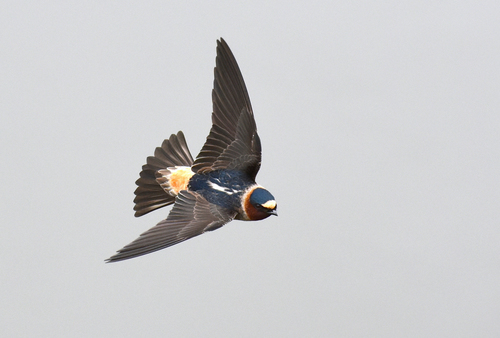
You might spot Cliff Swallow, Baldcypress, and Indian Heliotrope.
View guide →
Illinois, US
You might spot Cliff Swallow, Baldcypress, and Indian Heliotrope.
View guide →
Take the discovery with you
Snap it with Snappit to identify it, learn what makes it special, and add the discovery to your collection.


















