





Red-shouldered Bug
Jadera haematoloma
The Red-shouldered Bug is a colorful insect with bright red shoulders and a black body. They love to hang out on plants and are often seen in gardens, making them fun to spot!
Habitat: Urban areas
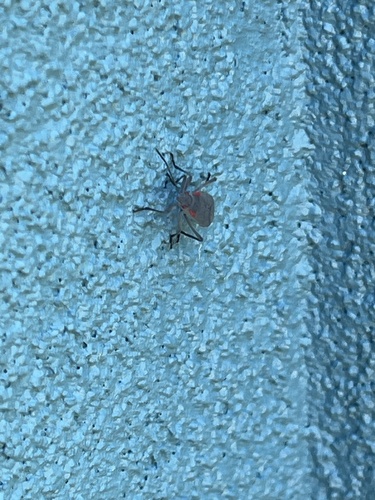
The Red-shouldered Bug has a distinctive black body, contrasting sharply with bright reddish-orange markings on its 'shoulders' (pronotum) and head. Its transparent wings reveal delicate black veins, and its legs are typically red, making it easy to identify from other dark-bodied insects.
Category
InsectsRarity
Common
Danger
1/5 · Very low
Snaps
3
Baby red-shouldered bugs are called nymphs and are almost entirely bright red!
If threatened, some can release a stinky scent to make predators think twice!
These bugs often gather in piles of hundreds, especially during colder weather!
They're sometimes called 'soapberry bugs' because they love soapberry tree seeds!
Red-shouldered Bug can access hidden nutrients in seeds because of its needle-like mouthparts that helps them puncture tough exteriors.
Red-shouldered Bug has vibrant red and black colors that helps them warn predators they might taste bad or are toxic.
Red-shouldered Bug can form large groups with other bugs because of a natural instinct that helps them deter predators and find mates.
Red-shouldered Bug can quickly escape danger using its transparent wings that helps them fly between food sources and avoid threats.
They mostly drink the juices from fallen seeds.
Sapindus saponaria
Its primary food source of mature seeds.
Acer negundo
Often aggregates on these trees for safety and overwintering.
Anolis carolinensis
A common lizard predator in its range.

Parus carolinensis
A small bird that will opportunistically feed on insects.
Social animals live in organized groups, cooperating for survival benefits such as foraging, defense, and raising offspring.
Colorful describes organisms or objects displaying a wide range of bright and distinct colors.
This trait characterizes organisms whose diet consists entirely or primarily of plant material.
Describes plants that are particularly attractive and beneficial to a wide range of pollinating organisms.

Diurnal animals are primarily active during daylight hours, typically resting or sleeping at night.

This habitat trait indicates species that can coexist with humans in urban and suburban environments, utilizing man-made structures and green spaces.

Describes organisms that transfer pollen, enabling the fertilization and reproduction of plants.
No aliases listed yet.
Danger
1/5 · Very low
These bugs are safe to observe, but it's best not to touch them.
The easiest way to identify Red-shouldered Bug is to use the Snappit nature identifier app.
10-14 mm
60-180 days
They mostly drink the juices from fallen seeds.
Urban areas
Foraging
6
Zoom in to split clusters and explore where this object has been snapped.
Jun 19, 2026
BroadmoorPhoto attribution
(c) Elliot Greiner, some rights reserved (CC BY)
License: CC BY 4.0 ↗
Image may be shown cropped inside the card frame.

Louisiana, US
You might spot Brown Anole, White Ibis, and Duck.
View guide →

District of Columbia, US
You might spot Spotted Lanternfly and Eastern Gray Squirrel.
View guide →

District of Columbia, US
You might spot Eastern Gray Squirrel, Spotted Lanternfly, and Duck.
View guide →

Florida, US
You might spot Brown Anole, Great Egret, and Snowy Egret.
View guide →

District of Columbia, US
You might spot Eastern Gray Squirrel, Spotted Lanternfly, and Duck.
View guide →

District of Columbia, US
You might spot Spotted Lanternfly and Eastern Gray Squirrel.
View guide →
Take the discovery with you
Snap it with Snappit to identify it, learn what makes it special, and add the discovery to your collection.







.jpg&width=800)



