

Lilford'S Wall Lizard
podarcis lilfordi
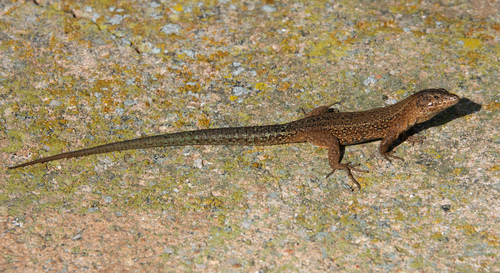
Lilford's wall lizard (Podarcis lilfordi) is an extraordinary reptile endemic to the small, rocky islets surrounding Mallorca, Menorca, and the Cabrera Archipelago in Spain's Balearic Islands. Extinct on the main islands due to centuries of human-introduced predators, this resilient lizard has survived in isolated pockets, evolving into over twenty distinct, localized subspecies. These lizards are exceptionally bold and curious, adapted to harsh, food-scarce island environments where they play a vital role as pollinators and seed dispersers. They are highly active during the day, darting confidently across bare rocks in search of food or basking spots, capturing the fascination of visiting biologists and nature enthusiasts alike.
Habitat: Found on rocky coastal islets and scrublands characterized by limestone cliffs, sparse vegetation, and dry stone walls.
This robust lizard typically measures 15 to 22 centimeters in total length, including its tail. Its coloration is highly variable depending on the islet of origin: some populations are entirely melanistic, displaying deep, dark blue or velvety black scales, while others feature intricate combinations of green, brown, or grey with black longitudinal stripes and spots. It possesses a pointed head, strong limbs designed for scrambling over rocks, and a slender tail that is longer than its body.
Category
ReptilesRarity
Common
Danger
1/5 · Very low
Snaps
Be the first to snap!
Due to their isolation on separate islets for thousands of years, taxonomists have identified and named over twenty distinct subspecies, each with its own unique color patterns.
On many uninhabited islets where they have no natural mammalian predators, these lizards are incredibly bold and will fearlessly climb onto human visitors in search of crumbs or sweat.
They have largely taken over the ecological niche of insect pollinators on their home islets, which is an extremely rare behavior among lizards worldwide.
Regularly visits flowers to feed on nectar and pollen, acting as an essential pollinator for several endemic Balearic plants.
Can deliberately detach its tail when seized by a predator, leaving the wriggling tail behind as a distraction while the lizard escapes.
Rapidly adjusts its body temperature by basking on sun-warmed rocks or retreating into deep crevices to survive intense Mediterranean heat.
An opportunistic feeder that supplements an insect-based diet with flower nectar, pollen, fruits, and organic debris.
Dracunculus muscivorus
The lizard feeds on flies attracted to this plant's carrion-mimicking odor and eats its fruits, dispersing the seeds.
Falco eleonorae
An agile aerial predator that breeds on the same islets and hunts these lizards to feed its nestlings.

Euphorbia dendroides
Consumes the fleshy orange fruits of this shrub, acting as one of its primary seed dispersal agents.
No trait badges are assigned for this object yet.
No aliases listed yet.
Collections for this object will appear here as more themes are added.
Danger
1/5 · Very low
No special safety notes yet.
Compare toes, scales, head shape, crests and tail proportions. Many lizards can drop and regrow their tails, so a short tail isn't always a species trait. Lizard Identifier: upload a photo and compare the visible details.
15+ cm
0.005+ kg
5+ years
12 km/h
An opportunistic feeder that supplements an insect-based diet with flower nectar, pollen, fruits, and organic debris.
Found on rocky coastal islets and scrublands characterized by limestone cliffs, sparse vegetation, and dry stone walls.
Foraging
Zoom in to split clusters and explore where this object has been snapped.
Recent snaps will appear here as new observations are added.
Take the discovery with you
Snap it with Snappit to identify it, learn what makes it special, and add the discovery to your collection.