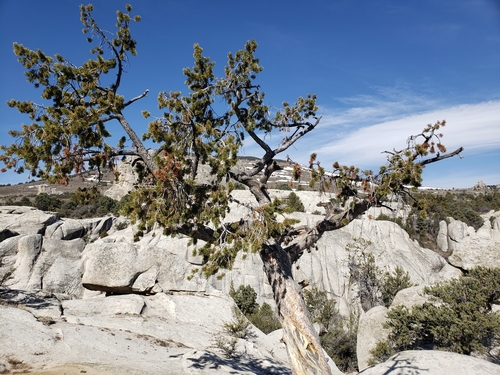


Limber Pine
pinus flexilis
The Limber Pine (Pinus flexilis) is a legendary survivor of the high-altitude wilderness of western North America. Renowned for its extraordinary resilience, this slow-growing conifer thrives in some of the most inhospitable environments on Earth, clinging to windswept rocky ridges and subalpine slopes where few other trees can survive. It gets its common name from its exceptionally pliable, rubbery branches, which can bend dramatically under heavy snow loads or fierce mountain gales without snapping. For centuries, these long-lived sentinels have stood watch over the mountains, with some ancient individuals reaching ages of over 1,000 years. The limber pine plays a vital ecological role in stabilizing soil, buffering alpine winds, and providing high-energy seeds that nourish mountain wildlife. Its unique relationship with Clark's nutcracker is a classic example of coevolution, shaping the very distribution of high-country forests.
Habitat: Found on dry, rocky ridges and steep, windswept slopes at high elevations in western North America.
The Limber Pine typically grows to a height of 5 to 20 meters, often adopting a stunted, multi-trunked, or twisted shape, known as krummholz, in exposed alpine environments. Its needles are dark green to blue-green, measuring 3 to 8 centimeters long, and grow in tight bundles of five. The bark is smooth and light grey on young trees, but matures into dark, deeply fissured plates. Its egg-shaped cones are 7 to 15 centimeters long, boasting thick, woody scales that lack the sharp prickles found on many other pine cones, and contain large, virtually wingless seeds.
Category
PlantsRarity
Common
Danger
1/5 · Very low
Snaps
1
Its scientific name, 'flexilis', refers to its incredibly bendable branches, which can occasionally be tied into a loose knot without fracturing.
One ancient limber pine growing in Utah, known as the 'Jardine Juniper' before it was correctly identified as a limber pine, is estimated to be over 1,500 years old.
Unlike most pines whose seeds are dispersed by the wind, the heavy, wingless seeds of the limber pine depend almost entirely on birds to carry them to new soil.
Its branches are incredibly pliable and tough, allowing them to bend into extreme positions under heavy snow and high winds without breaking.
Possesses a deep root system and needles with a thick waxy coating to conserve moisture in arid, high-altitude soils.
Produces wingless seeds that rely almost entirely on birds to extract and cache them, helping the tree disperse uphill against the wind.
As a photosynthetic plant, the limber pine manufactures its own food using sunlight, carbon dioxide, water, and minerals absorbed through its root system.
.jpg&width=800)
Nucifraga columbiana
Provides critical, nutrient-rich seeds which are harvested, cached, and eaten by this specialized bird, which in turn acts as the tree's primary means of seed dispersal.
Cronartium ribicola
An invasive fungal pathogen that infects and often kills limber pines by girdling the branches and trunk.
Dendroctonus ponderosae
Larvae tunnel under the bark to feed on the phloem, which can kill healthy or stressed trees during outbreaks.
No trait badges are assigned for this object yet.
No aliases listed yet.
Collections for this object will appear here as more themes are added.
Danger
1/5 · Very low
No special safety notes yet.
The easiest way to identify Limber Pine is to use the Snappit nature identifier app.
500-2600 cm
100-2000 years
As a photosynthetic plant, the limber pine manufactures its own food using sunlight, carbon dioxide, water, and minerals absorbed through its root system.
Found on dry, rocky ridges and steep, windswept slopes at high elevations in western North America.
Zoom in to split clusters and explore where this object has been snapped.

Utah, US
You might spot Common Golden-Mantled Ground Squirrel and Steller's Jay.
View guide →

Utah, US
You might spot Common Golden-Mantled Ground Squirrel and Steller's Jay.
View guide →

Idaho, US
You might spot Limber Pine and Dwarf Purple Monkeyflower.
View guide →

Utah, US
You might spot Common Golden-Mantled Ground Squirrel and Steller's Jay.
View guide →
Take the discovery with you
Snap it with Snappit to identify it, learn what makes it special, and add the discovery to your collection.











.jpg&width=800)



_001.jpg&width=800)




