.jpg&width=800)





Clark's Nutcracker
Nucifraga columbiana
Clark's Nutcracker is a clever bird that loves to eat seeds from pine cones. They have beautiful gray feathers and a strong beak to crack open tough seeds. These birds are great at finding food in the mountains!
Habitat: Mountain regions
The Clark's Nutcracker is a striking, medium-sized bird, predominantly pale gray with contrasting black wings and a black tail. It has distinct white patches on its wings and outer tail feathers. Its long, pointed bill is perfectly adapted for extracting seeds.
Category
BirdsRarity
Common
Danger
1/5 · Very low
Snaps
36
A single nutcracker can cache over 98,000 seeds in one season, enough for many new trees!
Instead of drinking water, Clark's Nutcrackers often eat snow to stay hydrated high in the mountains!
These birds build nests and lay eggs in sub-zero temperatures, often while snow is still on the ground!
They can carry up to 80 pine seeds in a special pouch under their tongue!
Clark's Nutcracker can remember up to 33,000 hidden seed caches for months, helping them find food even under snow.
Clark's Nutcracker has a long, pointed bill that helps them expertly pry nutritious seeds from tough pine cones.
Clark's Nutcracker buries thousands of seeds, which helps new pine trees grow, making them vital for mountain forests.
These clever birds love to eat pine nuts, especially from whitebark pines, but also enjoy insects!
.jpg&width=800)
Pinus albicaulis
Nutcrackers disperse seeds, helping the pines regenerate in harsh environments.
Pinus edulis
They are a primary disperser of Pinyon Pine seeds across their range.
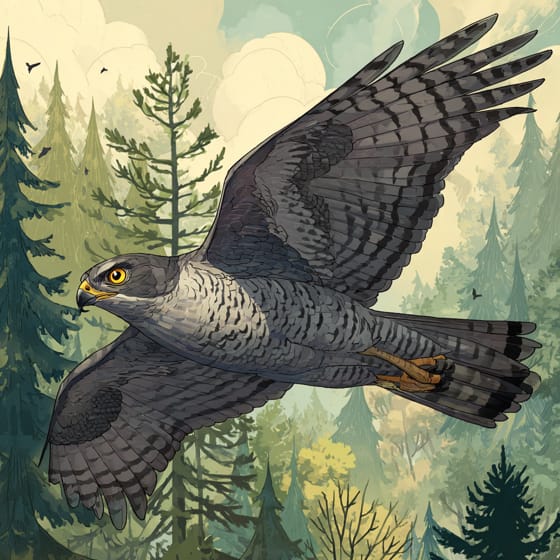
Accipiter gentilis
Northern Goshawks are known predators of Clark's Nutcrackers.
Feathered describes animals, primarily birds, possessing a covering of feathers.
Social animals live in organized groups, cooperating for survival benefits such as foraging, defense, and raising offspring.
This trait identifies organisms whose diet includes both plant and animal matter.
Singing animals produce complex vocalizations, often for purposes of attracting mates, defending territory, or communicating within their species.

This trait describes organisms that manipulate external objects to achieve a specific goal.

This habitat trait identifies species found in mountainous regions, characterized by high elevation, steep slopes, and varying climate zones.

Diurnal animals are primarily active during daylight hours, typically resting or sleeping at night.

Describes a species whose presence and role have a disproportionately large effect on its environment.
No aliases listed yet.
Danger
1/5 · Very low
Enjoy watching birds from a distance and don't try to touch them.
The easiest way to identify Clark's Nutcracker is to use the Snappit nature identifier app.
27-30 cm
46-49 cm
0.106-0.161 kg
15-19 years
50 km/h
These clever birds love to eat pine nuts, especially from whitebark pines, but also enjoy insects!
Mountain regions
Zoom in to split clusters and explore where this object has been snapped.

Wyoming, US
You might spot Elk, Killdeer, and Black-Billed Magpie.
View guide →

Oregon, US
You might spot White Pasqueflower and Clark's Nutcracker.
View guide →

British Columbia, CA
You might spot Oregon Grape, Shinyleaf Meadowsweet, and Bush Penstemon.
View guide →

British Columbia, CA
You might spot White Pasqueflower and Columbian Ground Squirrel.
View guide →
Nevada, US
You might spot African Lion, Tiger, and Zebra.
View guide →

Idaho, US
You might spot Limber Pine and Dwarf Purple Monkeyflower.
View guide →
Take the discovery with you
Snap it with Snappit to identify it, learn what makes it special, and add the discovery to your collection.




.jpg&width=800)









