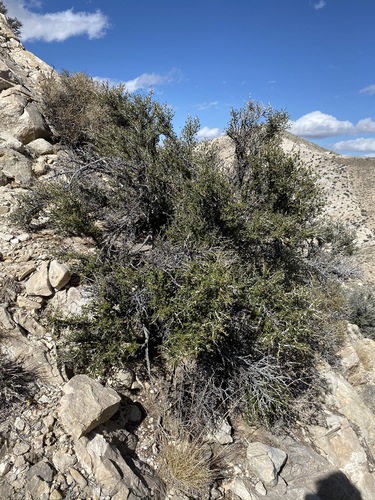


Littleleaf Mountain Mahogany
cercocarpus intricatus
The Littleleaf Mountain Mahogany is a resilient, intricately branched evergreen shrub native to the arid, rocky landscapes of the American Southwest. Perfectly adapted to survival in harsh, sun-drenched environments, this tough plant often clings to limestone cliffs, canyon walls, and gravelly slopes where few other species can thrive. Despite its rugged exterior, it is a crucial player in its ecosystem, providing vital browse for local wildlife and helping to stabilize loose soil. What makes this shrub truly fascinating is its ability to live for over a century in severe desert conditions and its unique evolutionary tricks. From nitrogen-fixing root nodules to spiraled, feathery seed tails that self-sow into the hard earth, every part of this plant is engineered for endurance. It is a stunning example of how life persists and flourishes in the most challenging terrains.
Habitat: Found on dry, rocky limestone cliffs, canyon ledges, and steep talus slopes in arid montane regions.
This slow-growing shrub stands between 50 to 250 centimeters tall, characterized by a dense, tangled, and highly branched growth habit that gives it a rigid, almost thorny appearance. Its tiny, linear leaves are dark green above and covered in fine, white hairs underneath, with tightly rolled-under margins that help conserve moisture. In spring, it produces small, solitary, yellowish-white flowers without petals. The most striking visual feature appears in late summer when the seeds develop long, feathery, corkscrew-like tails that shimmer in the desert sunlight, catching the wind to aid in dispersal.
Category
PlantsRarity
Common
Danger
1/5 · Very low
Snaps
Be the first to snap!
Despite its common name, it is a member of the Rose family (Rosaceae) and is not closely related to true tropical mahoganies.
Its wood is exceptionally dense and heavy, so much so that dry pieces will sink in water instead of floating.
The scientific genus name Cercocarpus translates to 'tail fruit,' directly referencing the striking, feathery plume attached to each seed.
The seeds possess a long, feathery plume that curls and uncurls in response to changes in humidity, physically screwing the seed into the hard ground to ensure successful germination.
The leaves are tiny with deeply rolled-under margins and a hairy underside, which traps a layer of humid air and drastically reduces water loss in dry environments.
In partnership with soil bacteria, it forms root nodules that convert atmospheric nitrogen into a usable form, allowing it to thrive in nutrient-poor soils.
As a photoautotrophic plant, it produces its own energy via photosynthesis, utilizing sunlight, carbon dioxide, water, and essential soil nutrients.

Odocoileus hemionus
Browses on the evergreen leaves during the winter months when other food sources are scarce.
Frankia
Forms a symbiotic relationship in root nodules to fix nitrogen from the atmosphere into the soil.
Ovis canadensis nelsoni
Feeds on the rigid leaves and twigs in rocky, mountainous habitats.
No trait badges are assigned for this object yet.
No aliases listed yet.
Collections for this object will appear here as more themes are added.
Danger
1/5 · Very low
No special safety notes yet.
Start with the whole plant, then compare leaf arrangement, leaf edges, stems and any flowers or fruit. Opposite leaves grow in pairs; alternate leaves come one at a time along the stem. These details tell you far more together than a single green leaf does. Plant Identifier: upload a photo and compare the visible details.
50+ cm
50+ years
As a photoautotrophic plant, it produces its own energy via photosynthesis, utilizing sunlight, carbon dioxide, water, and essential soil nutrients.
Found on dry, rocky limestone cliffs, canyon ledges, and steep talus slopes in arid montane regions.
Zoom in to split clusters and explore where this object has been snapped.
Recent snaps will appear here as new observations are added.
Take the discovery with you
Snap it with Snappit to identify it, learn what makes it special, and add the discovery to your collection.