

London Plane
platanus × hispanica
The London Plane is a magnificent, resilient deciduous tree that has become a defining feature of urban landscapes worldwide, most famously lining the streets of London and other major cities. A hybrid between the Oriental plane and the American sycamore, this tree combines the grand stature of its parent species with an extraordinary tolerance for city life. It is particularly celebrated for its ability to thrive in compacted soils and withstand high levels of atmospheric pollution. This hardiness, combined with its broad canopy providing generous shade, has made it one of the most widely planted ornamental urban trees in temperate zones.
Habitat: Commonly found in temperate urban areas, city streets, parks, and cultivated landscapes, where it is planted for shade and ornament.
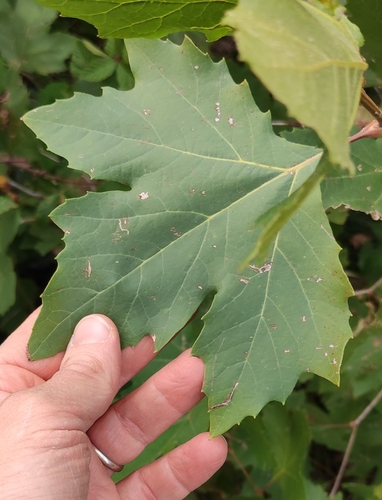
The London Plane is instantly recognizable by its striking, mottled bark, which flakes off in large irregular patches to reveal a mosaic of pale green, grey, cream, and brown underneath. It boasts large, palmately lobed leaves that closely resemble maple leaves, featuring five distinct lobes with coarsely toothed margins. In autumn, these leaves turn a rich, golden brown. Its fruit consists of distinctive, ball-shaped seed heads that hang in pairs or small clusters from long stalks, remaining on the branches well into winter.
Category
PlantsRarity
Common
Danger
1/5 · Very low
Snaps
Be the first to snap!
It was heavily planted in London during the Industrial Revolution because it was one of the few trees that could survive the city's intense coal smoke.
The fuzzy hairs on the underside of its leaves can be a minor irritant to humans and may trigger coughing when shed in spring.
The tree's peeling bark is a self-cleaning mechanism that helps it shed soot, dust, and other urban pollutants.
Sheds its outer bark in patches to rid itself of trapped urban pollutants and soot, allowing the tree to breathe through its trunk.
Highly resistant to atmospheric particulates, sulfur dioxide, and ozone, making it exceptionally adapted to dense urban environments.
Possesses a robust, adaptable root system that can survive in highly compacted urban soils with low oxygen levels.
As a photosynthetic plant, the London Plane synthesizes its own food using sunlight, water, and carbon dioxide.
Corythucha ciliata
A lace bug species that feeds on the sap of the leaves, occasionally causing significant defoliation.

Sciurus carolinensis
Nests in the canopy and feeds on the seeds of the tree.
No trait badges are assigned for this object yet.
No aliases listed yet.
Collections for this object will appear here as more themes are added.
Danger
1/5 · Very low
No special safety notes yet.
Start with the whole plant, then compare leaf arrangement, leaf edges, stems and any flowers or fruit. Opposite leaves grow in pairs; alternate leaves come one at a time along the stem. These details tell you far more together than a single green leaf does. Plant Identifier: upload a photo and compare the visible details.
2000-4000 cm
5000-20000 kg
150-350 years
As a photosynthetic plant, the London Plane synthesizes its own food using sunlight, water, and carbon dioxide.
Commonly found in temperate urban areas, city streets, parks, and cultivated landscapes, where it is planted for shade and ornament.
Zoom in to split clusters and explore where this object has been snapped.
Recent snaps will appear here as new observations are added.
Take the discovery with you
Snap it with Snappit to identify it, learn what makes it special, and add the discovery to your collection.